
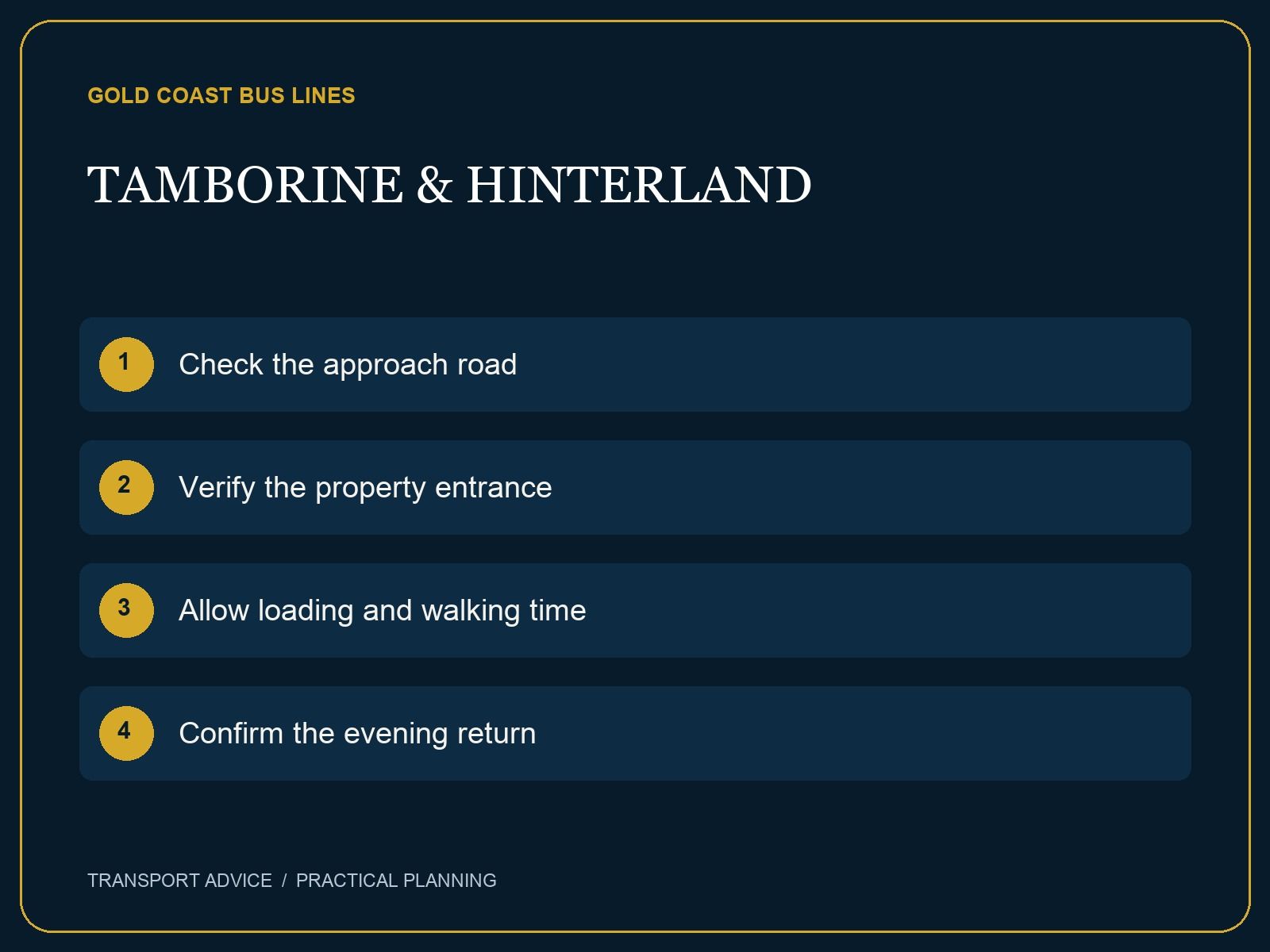
Tamborine Mountain and the wider Gold Coast hinterland can suit a memorable group day, retreat or wedding. They also need a different transport brief from a coastal hotel transfer. Road suitability, private entrances, turning space and the return after dark can determine the workable vehicle before the organiser reaches the question of seats.
Use this guide to prepare the route, venue and passenger information for a Tamborine Mountain visit or a wider hinterland itinerary. The Gold Coast Hinterland location page provides the service enquiry pathway once the main requirements are clear.
Start with the approach road, not the shortest route
A navigation app may suggest a route that makes sense for a car but not for the proposed vehicle. Queensland Parks’ Tamborine visiting guidance specifically identifies the steep, narrow roads from Nerang and Canungra as unsuitable for buses, trailers, caravans and trucks. Give the operator the whole itinerary and ask them to assess a suitable approach; do not prescribe a shortcut.
Check current road conditions and closures through QLDTraffic and relevant venue or park notices before travel. A route that was used on a previous outing is not proof that it is available or appropriate on the next date. Weather, works and access arrangements can change.
The hinterland is not one uniform destination. A route suitable for a Tamborine venue does not automatically suit a different mountain, park section or rural property. If the trip includes several districts, list each address and allow the operator to review every connecting leg. Avoid presenting the entire hinterland as one short sightseeing loop.
Obtain useful venue access information
Ask the venue for its nominated bus entrance and the largest vehicle it can accommodate. Request written access instructions, a map where available and an onsite contact. “Coaches visit here” is useful background but does not confirm that the particular vehicle can use every entrance or park there during the event.
Discuss the approach width, bends, overhead clearance, gradients, surface, turning area and safe place for passengers to stand. Tell the operator about trailers or unusual luggage needs at the same time, because they can affect manoeuvring. A venue should identify its own restrictions; the transport provider must still assess vehicle suitability.
| Access question | Why it matters | Who should confirm |
|---|---|---|
| Which entrance is for buses? | Avoids a car-only driveway or wrong approach | Venue, then operator |
| Can the vehicle turn and leave safely? | Drop-off access must include a workable exit | Operator using venue details |
| Where do passengers wait? | Separates the group from moving vehicles | Venue and organiser |
| Can the vehicle remain onsite? | Set-down permission may exclude waiting | Venue and operator |
| What changes after dark or rain? | Lighting and surfaces affect the return plan | Venue and operator |
Send photographs only as supporting information. A wide-angle image can hide a tight turn, and a photograph taken in daylight does not explain lighting after an evening reception. Where uncertainty remains, settle the access question before promising door-to-door arrival to guests.
Choose vehicles around the limiting part of the trip
The narrowest or most constrained confirmed access point can govern the vehicle plan. If one venue cannot take the proposed coach, options may include changing the stop, using another approved loading area or arranging smaller vehicles. Each alternative needs assessment; a minibus is not automatically suitable for every mountain road or property.
Use the fleet overview to discuss seating categories, then supply the exact passenger count and belongings. Keep families or supervised groups together where required. If smaller vehicles are proposed, check whether they can carry everyone simultaneously and whether each has adequate storage for the allocated load.
For a large group, do not assume repeated shuttle trips will preserve the original arrival time. The cycle includes loading, driving, unloading, returning and boarding the next group. The one bus or multiple buses guide helps compare those arrangements, while the operator confirms whether the route and schedule are practical.
Keep a day itinerary deliberately manageable
Choose the main reason for the trip: a long lunch, a booked experience, a wedding or a relaxed visit. Build the day around that commitment and add only stops that fit. A schedule with six brief visits can leave passengers constantly boarding instead of enjoying the destination.
For each stop, allow time to gather the group, walk to and from the vehicle, use facilities where available and check attendance. Travel distance alone is a poor measure of how much the stop consumes. Tell passengers which visit is optional so the organiser can omit it if earlier movements take longer.
Where a stop involves a park or walking track, check the official location information, current alerts, suitability for the group and permitted vehicle access. The Tamborine National Park guidance should be read for the relevant section. A scenic photograph is not evidence of a suitable bus loading place.
Plan for people who need an easier day
Ask about walking distance and boarding needs before finalising activities. Some passengers may be comfortable on the bus but unable to manage a steep walk from an alternative drop-off point. Others may need step-free boarding or to remain in a wheelchair. Describe these requirements to the operator and venue before booking.
Include a suitable rest option where the planned activity allows it, and clarify who remains with passengers who do not join a walk. The driver should not be assumed to supervise people during an excursion. For school or supported groups, the organiser needs its own supervision arrangements.
Let passengers know what to bring for the confirmed itinerary, including appropriate clothing and essential personal items. Keep those instructions specific to the activities and forecast. Do not present a general mountain bus trip as an assurance that every attraction is accessible to every traveller.
Treat weddings and evening returns as a separate exercise
A daytime site visit does not settle an evening transport plan. Confirm that the bus entrance, waiting area and paths will be lit, that gates will be open and that someone can direct the group after the event. The venue contact should know the final pickup schedule.
Staged returns can help guests who leave early, but each departure needs its own capacity and passenger allocation. “An early bus and a late bus” is not enough when everyone may choose the late option. Ask guests for a preference, retain a controlled way to change it and ensure that no departure is over-allocated.
Use the wedding transport guide for the broader guest movement and wedding bus hire for the service enquiry. Keep ceremony timing, reception finish, hotel distribution and access instructions together so the operator sees the full commitment.
Worked scenario: a lunch and two optional visits
Consider 30 guests departing from two coastal hotels for a mountain lunch. The first draft includes an attraction before lunch and another after it. The lunch venue accepts the proposed vehicle subject to its nominated approach, but the second attraction has unresolved turning and parking arrangements.
The organiser sends all three locations for review and labels the second attraction optional. Rather than assume a coach can get there, the group chooses a workable alternative if access is not confirmed. Lunch remains the fixed anchor, with arrival time allowing passengers to unload and walk in before the booking.
The operator assesses the road route and the total day. The organiser gives guests meeting times at each hotel, an expected return window and a clear final assembly point. If the optional stop is removed, passengers gain more time at the main visit rather than being taken to an unverified roadside collection point.
Build a weather and change plan
Decide what happens if a venue closes, conditions deteriorate or a planned outdoor visit no longer suits the group. An alternative should be confirmed with the venue and operator, not simply chosen from a map while the bus is already moving. Changing destinations may change the route, duration and price.
Nominate one person who can approve itinerary changes. That person should hold the current passenger list, venue contacts and booking reference. Other passengers can suggest changes through the organiser, but conflicting requests should not go directly to the driver.
Ask the operator how it handles a route that becomes unsuitable on the day. The written booking should make clear how communication and any alternative arrangements are managed. Do not publish a guaranteed arrival or access promise that depends on conditions outside the organiser’s control.
Send a complete mountain transport brief
Provide the date, passenger count, coastal pickups, every destination address, venue access instructions, fixed booking times, expected finish and all return stops. Include luggage, equipment and boarding requirements, even for a day trip. Mention whether a trailer has been suggested so it is included in the access assessment.
Separate confirmed details from decisions still pending. A short list of open questions is more useful than a polished itinerary containing assumptions. Once the operator and venues agree on the plan, send passengers a simple version with meeting times and the contact person.
For a sightseeing programme, start with tour bus hire. For a retreat or private event, use private group transport. Request a quote with the venue information attached or supplied through the agreed booking channel, rather than asking for a price based only on “Tamborine, 30 people”.
Frequently asked questions
Can a full-size coach travel to Tamborine Mountain?
The operator must assess the proposed route and every destination. Some approaches are identified as unsuitable for buses by Queensland Parks, and private venues have their own constraints. Do not treat access to one venue as approval for all mountain locations.
Is a smaller bus always a solution to restricted access?
No. Vehicle dimensions are only one consideration. Gradients, surface, turning, route restrictions, luggage and passenger needs still require assessment. Changing a stop may be more workable than changing vehicles.
Can we use a public lookout as our pickup point?
Only after the operator confirms a suitable, permitted loading arrangement. A parking area or roadside viewpoint may not support group boarding or waiting. Agree on the exact point before telling passengers where to assemble.
Should we book an early and late wedding return?
It can be useful when demand and vehicle availability support it. Allocate passengers to each departure and confirm capacity, venue access after dark and the last collection. An unallocated late return can create an avoidable capacity problem.