
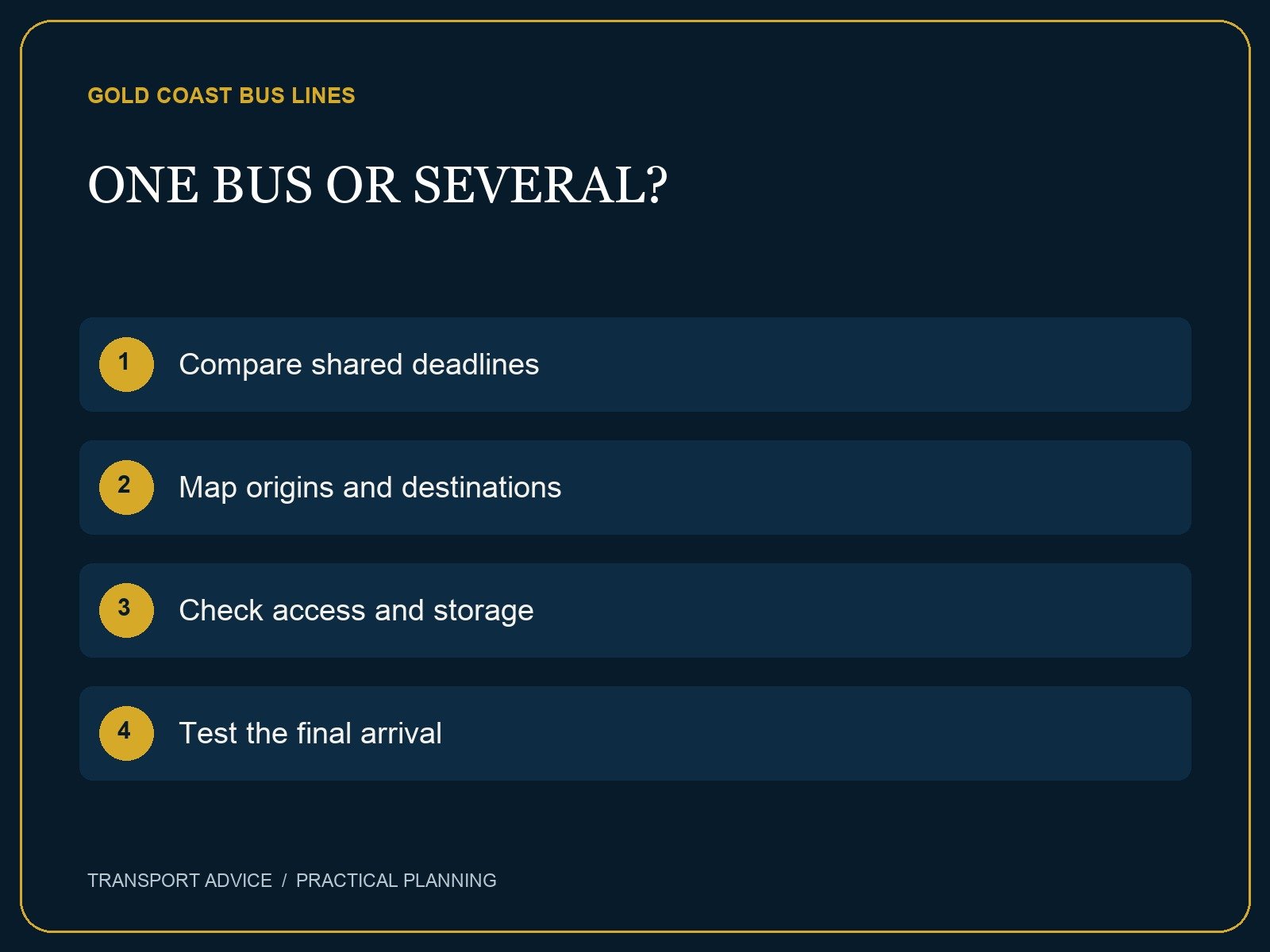
One larger bus can keep a group together and simplify attendance. Several vehicles can shorten hotel circuits, serve different deadlines or fit constrained access. Neither is automatically better. The useful comparison starts with the passengers’ movement and ends with a complete timetable, rather than beginning with a preference for the biggest or smallest vehicle.
This guide helps compare a single coach, several direct services and repeated shuttle trips. For larger events needing detailed coordination, use the 100–200+ passenger guide. Here the focus is the choice between operating patterns and the questions that reveal which pattern fits.
Start with what the group shares
List the origin, destination and required arrival for each subgroup. If everybody starts together, travels to the same suitable venue and returns at one time, a single vehicle may be straightforward. If those conditions differ, the apparent simplicity can disappear into extra stops and waiting.
Ask which groups must stay together. Families, supervised students, teams or delegates with their own coordinator may need a particular allocation. Splitting them simply to fill every seat can create more work than using a different vehicle combination.
Record luggage and boarding needs before comparing capacities. The fleet overview shows seating categories, but the operator must confirm the specific arrangement for people, belongings and access. A seating match without a storage match is not a complete option.
When one larger vehicle can work well
A single vehicle gives the organiser one main departure, one attendance check and a shared arrival. It can suit groups with a common meeting place and timetable, provided the route and both loading points accommodate the proposed vehicle.
It may also make sense when the group wants to travel together between several confirmed stops. The organiser can brief everyone at once, and passengers do not need to track which smaller vehicle they joined. These advantages depend on the vehicle’s suitability and the accepted booking, rather than size alone.
Check the exceptions before deciding. One guest requiring a materially different return, a private venue with constrained access or several widely separated hotels may change the comparison. A small separate movement can sometimes protect the main schedule without fragmenting the whole group.
When multiple direct vehicles can help
Separate vehicles can depart from different hotels without a long collection circuit. They can also serve different destinations or arrival windows. This may reduce time spent onboard for the first pickup group and avoid forcing passengers with unrelated plans into one route.
The trade-off is coordination. Each vehicle needs a passenger allocation, loading instructions, contact person and clear identity. The organiser must know which group belongs where and how any change affects the other departures. More vehicles do not remove the need for a single controlled schedule.
Venue capacity still matters. If several vehicles arrive at a loading area that accepts only one at a time, sequence them. Do not assume that splitting the group produces simultaneous entry to the event. Arrival processing, walking and registration can become the next constraint.
Compare direct services with a shuttle cycle
A shuttle repeats the same or a similar movement. It can suit arrivals spread over time, but it requires a realistic cycle and somewhere for passengers to wait. The complete cycle includes loading, travel, unloading, repositioning, return travel and recovery.
Suppose 80 guests need transport and a proposed vehicle has 40 confirmed usable seats. Two loads provide enough seats in total. If the second load reaches the venue after the required arrival, however, the option does not meet the brief. Capacity across two trips is not the same as capacity at the deadline.
| Pattern | Potential advantage | Question that can rule it out |
|---|---|---|
| One larger vehicle | Shared departure and simple attendance | Can it access every required stop? |
| Several direct vehicles | Different origins or deadlines | Can the venue handle the arrival sequence? |
| Repeated shuttle | Capacity spread across a longer window | Does the last load arrive in time? |
| Main vehicle plus small transfer | Protects the main group schedule | Is the separate movement fully booked and allocated? |
Ask the operator to show the timetable behind a shuttle proposal. A price without the final arrival, waiting arrangement and passenger allocation is difficult to compare with a direct service.
Test hotel geography and first-passenger time
Map the exact pickups rather than just suburbs. Hotels that look close can require different approaches, and loading arrangements may prevent a simple loop. The operator should assess the stop order and vehicle access.
For each option, record how long the earliest passengers remain onboard before the final pickup. That measure often reveals whether one bus is becoming inconvenient. A short journey to the event can still involve a long overall trip for the first hotel group.
Compare that with consolidation at a common point. Walking or arranging separate travel to meet the bus may be easy for some guests and unsuitable for others. Use the multiple-pickup guide to assess the practical burden instead of assuming a central point is always efficient.
Check access and storage on every option
A larger coach needs suitable approaches, turning and loading space. Smaller vehicles may offer different dimensions, but they are not automatically acceptable at a restricted venue. Ask the venue for written instructions and let the operator confirm suitability.
If a larger group is split, divide the luggage inventory too. Two vehicles with sufficient combined storage may still fail if most bulky items belong to passengers allocated to one of them. Avoid a plan that requires constant movement of bags between vehicles at busy stops.
For golf, airport and cruise trips, consult the dedicated golf guide, airport guide or cruise guide. Those trips often make storage a deciding factor rather than a minor detail.
Compare return demand independently
The outbound arrangement does not have to dictate the return. A wedding may need a shared arrival but early and late departures. Conference guests may leave toward different airports after travelling together to the venue. Count the passengers for each return movement before copying the morning plan.
If an early departure uses a vehicle expected back for the final group, test its full cycle. Include all hotel drop-offs and the trip back to the venue. An early return that becomes a long multi-stop run can make the final departure unreliable.
Ask passengers for preferences and set a process for changing them. The late service should not become the unallocated fallback for everybody. Confirm usable capacity for each departure and keep the organiser’s list current.
Worked scenario: 72 guests in three hotels
Imagine 72 guests allocated as 30, 24 and 18 across three hotels. They share a venue arrival deadline, but the hotels are not all on a convenient loop. The organiser asks the operator to compare a suitable multi-vehicle arrangement with any workable shared-pickup alternative.
The comparison records each hotel’s assembly and departure, the last arrival at the venue and the number of loading movements. It also checks luggage and access at every stop. A vehicle combination that uses a few more spare seats might still produce a better passenger timetable than one that fills every seat through a complicated circuit.
On the return, 20 guests want to leave early. The organiser assesses that departure as its own movement and confirms whether it affects the final service. The choice is made from the complete schedule, not from a claim that multiple vehicles are always faster or that one arrangement must always cost less.
Compare prices on the same operating scope
Ask each proposal to identify the movements, vehicle categories, usable capacity, waiting commitment and return arrangements. Include any access fees, toll assumptions or additional runs that the provider says apply. A shorter operating commitment is not directly comparable with a vehicle retained throughout the event.
Use the pricing guide to compare transfer and charter structures rather than estimating a price from seats multiplied by a guessed rate. Actual availability and the itinerary determine the quote.
If one option saves money by asking passengers to wait longer, state that trade-off clearly. Organisers can then decide whether the waiting is acceptable. A workable budget decision is based on known consequences, not hidden omissions in the schedule.
Set a decision and confirmation process
Prepare a short comparison containing capacity, access, first pickup, final arrival, return departures and unresolved questions for each option. Eliminate any option that fails a fixed deadline or confirmed access requirement. Compare the remaining alternatives on cost, convenience and coordination effort.
Once selected, obtain confirmation from the operator and distribute the final allocation. Do not keep several draft vehicle patterns circulating among passengers. If the provider later proposes a vehicle substitution, confirm that seating, storage and access requirements remain satisfied.
Use group transport or event transport as the service starting point. Request a quote with the passenger groups and deadlines, and ask for alternatives only where the organiser is genuinely flexible. That gives the provider room to suggest a useful arrangement without leaving essential decisions unspecified.
Frequently asked questions
Is one large bus always cheaper?
No universal comparison applies. Route, operating time, access, availability and separate returns all affect the proposal. Compare complete quotes for the same movements and passenger requirements.
Do multiple buses need to travel together?
Not necessarily. Separate origins or destinations may be the reason for using them. Give each vehicle a clear allocation and schedule, and coordinate venue arrivals where loading space is shared.
Can we use one bus twice instead of two buses?
Only if the full cycle delivers the second group within the required window and waiting arrangements are acceptable. Ask for the final arrival time, not just confirmation that two loads fit.
What if only a few people need a different return?
Ask for a separate small movement to be assessed alongside the main service. Include their luggage and destination, and confirm it before telling passengers that the option is available.