
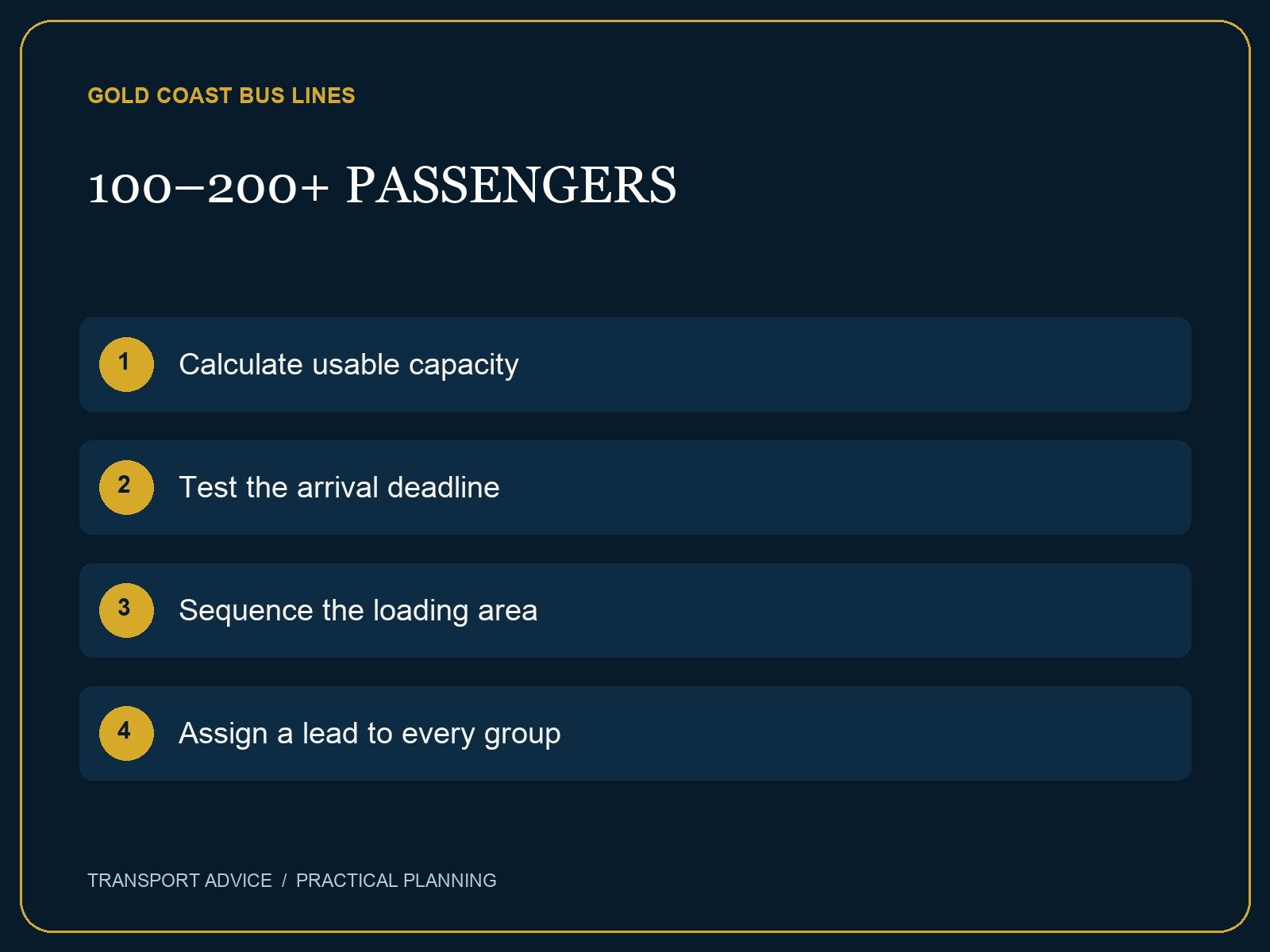
Moving 100, 150, 200 or more passengers is a coordination job as much as a vehicle booking. Enough seats are necessary, but the plan also needs enough loading space, a realistic arrival sequence and someone who knows which passengers belong on each departure. A queue can become the limiting factor even when several vehicles are ready nearby.
Begin with the deadline and the shape of the group. People departing from one venue behave differently from passengers spread across hotels or arriving on separate flights. Build a movement schedule before asking for a particular number of coaches, then invite the operator to assess capacity, access and timing together.
Count passengers by movement
Use a separate passenger count for each journey. A conference may add partners for dinner, a wedding may have early-return guests, and a school group may include teachers or support staff beyond the student total. Count everyone requiring a seat and identify groups that must remain together.
Distinguish registered attendance from transport demand. An event with 200 tickets may have 140 people using the outbound transport and 170 using the return. Those are two different capacity requirements. Ask passengers to register for the movements they need, and define how late additions will be handled.
List luggage and equipment by movement too. The final departure after hotel checkout can need more storage than the morning conference run. The vehicle-selection guide explains why storage and accessibility can change the usable arrangement even when a vehicle’s advertised seating category is unchanged.
Use capacity arithmetic as a starting point
Divide passengers by the confirmed usable seats and round up to establish a first estimate of vehicles or loads. Then test that estimate against the actual allocation. A result that works mathematically may split a supervised group or leave one hotel with more passengers than its assigned vehicle can take.
For example, 180 passengers divided by 50 usable seats means four simultaneous vehicle loads. If there were four suitable 50-seat vehicles available, their combined nominal capacity would be 200. This is an illustrative calculation, not a statement that those vehicles are available or that every itinerary can use them.
For 200 passengers on four 50-seat vehicles, every seat is allocated. A late addition would require a revised arrangement; there is no spare capacity simply because four vehicles sound substantial. Discuss a sensible allowance for uncertain attendance with the operator rather than inventing a universal spare-seat percentage.
Test the deadline before choosing repeated shuttle trips
A repeated shuttle can be practical when arrivals may be spread out. It can fail when everyone needs to be inside at the same time. Calculate the complete cycle, including loading, outbound travel, unloading, return travel and recovery time. Use operator-assessed durations and venue constraints.
As an arithmetic example, consider 180 passengers, two vehicles with 50 usable seats each, and a 40-minute full cycle. The first wave can carry 100, leaving 80 for a later wave. If boarding begins at 8:00 am and the first passengers arrive at 8:20 am, a second departure around 8:40 am cannot deliver its passengers at 8:30 am. The shared deadline fails even though two waves offer enough total seats.
The example’s times are not operational estimates. Its purpose is to expose the missing question: when does the last passenger arrive? Use one bus versus multiple buses to compare simultaneous departures with shuttle options for the actual route.
Check how the venue will receive the group
Ask how many vehicles can unload at once and where others can stage. Four coaches arriving together at a single loading bay create a sequence, not four simultaneous arrivals. Build that unloading sequence into the programme and confirm where passengers gather after leaving each vehicle.
Keep set-down, waiting and return loading arrangements separate. A venue may allow a brief arrival but require vehicles to move elsewhere. Obtain the venue’s written instructions and pass them to the operator, including any event-specific route or gate.
| Constraint | Question to resolve | Effect on the plan |
|---|---|---|
| Loading area | How many vehicles can board at once? | Departure sequence |
| Arrival area | How many can unload at once? | Final passenger arrival time |
| Waiting space | Where can vehicles remain? | Repositioning and return timing |
| Pedestrian space | Where do groups assemble safely? | Marshalling and signage |
| Access requirements | Which vehicle arrangements are suitable? | Allocation and boarding allowance |
For Gold Coast venue considerations, use the existing coach access and parking guide. Obtain the final arrangement for the actual event rather than relying on a previous organiser’s experience.
Give every departure a clear identity
Use route or group identifiers such as “Hotel A”, “Route 2” or “Early Return”. Apply them consistently to passenger messages, manifests and agreed signs. Do not rely on paint colour or a registration number that may change before the service is allocated.
Assign passengers before boarding wherever possible. At a single assembly point, separate queues or meeting groups can reduce people approaching the wrong vehicle. Use words and numbers as well as colour so the system remains understandable for everyone.
If people change groups, update both allocations. Removing a name from one list without adding it to the correct list creates uncertainty at departure; adding it without removing it can lead the first vehicle to wait unnecessarily. The organiser should control changes through one process.
Separate organiser and driver responsibilities
The driver needs to manage the vehicle and safe loading. The organiser should manage attendance, passenger instructions and event decisions. For a large movement, nominate a lead for each group and one overall transport coordinator who can communicate with the operator.
A group lead confirms who is present, identifies anyone missing and follows the agreed late-passenger procedure. The overall coordinator handles changes that affect several vehicles, the venue or the event programme. This avoids every marshal independently requesting a different departure time.
Prepare an escalation contact and a backup in case the primary organiser is unavailable. Share the minimum necessary contact details with the people using them, and keep passenger lists out of public signage. A useful manifest does not require collecting unrelated personal information.
Worked scenario: 210 guests leaving a dinner
Suppose 210 guests need to leave a venue after dinner, heading to three hotel areas. Their return allocations are 90, 70 and 50. The organiser cannot settle the plan by dividing 210 by the largest fleet category alone, because destinations and the venue’s loading capacity matter.
The operator compares a suitable vehicle combination and route allocation. The venue confirms how many vehicles can load at one time. Group leads assemble passengers by destination while the coordinator calls each allocated group forward in the agreed sequence.
If some guests want an earlier departure, those seats are allocated in advance and removed from the final wave. If demand shifts back to the late service, the coordinator checks remaining capacity before accepting the change. The final movement is not left to absorb everybody by default.
Plan for late people and disrupted timing
Agree what happens when somebody is missing at the scheduled departure. The group lead should know who to contact, how long any agreed hold may last and who can authorise it. Do not make the driver decide whether to delay an entire event for an unidentified passenger.
Ask the operator about its disruption process, including how it communicates delays and assesses alternatives. Do not advertise a guaranteed spare vehicle unless that provision is explicitly part of the booking. Contingency planning should describe confirmed arrangements, not create an unsupported promise.
Identify which deadlines can move and which cannot. A flexible hotel check-in may absorb a delay; a flight or timed event may not. Prioritising these constraints in the brief gives the operator useful information when reviewing the schedule.
Keep the working schedule controlled
Maintain one current schedule with an issue date or version. Record the date, route ID, passenger count, vehicle requirement, loading point, assembly, departure, arrival deadline, return and contact for every movement. Mark unresolved details so they do not become accidental instructions.
Before the event, reconcile the sum of all passenger allocations with the expected total. Then check each vehicle’s allocation against its confirmed usable capacity. Repeat that check when counts or vehicle arrangements change, rather than assuming a previous total remains valid.
Distribute shorter passenger instructions for each group. Most guests need their meeting place and time, not the operator’s complete vehicle schedule. Give marshals the detail necessary to manage their assigned movement and direct material changes through the transport lead.
Prepare the quote brief before committing numbers
Send the full movement schedule, venue instructions, passenger allocations, luggage and accessibility requirements through the quote page. If attendance is uncertain, provide a minimum, likely and maximum count and ask how each scenario affects the plan.
Use event transport or corporate bus hire as the service starting point. The 57-seater fleet page describes one seating category to discuss, but the final solution may combine vehicle sizes according to access, availability and route demand.
Compare proposals against the last passenger’s arrival and return, not just the number of vehicles supplied. A complete plan should explain which movements are covered, how waiting or additional runs are treated and what information still needs to be confirmed.
Frequently asked questions
How many buses do we need for 200 people?
Start with confirmed usable seating and round up, then assess destinations, luggage, access and shared deadlines. Four vehicles with 50 usable seats would provide exactly 200 seats, but that arithmetic alone does not confirm a workable or available solution.
Can fewer buses make several trips?
Yes, if the full cycle allows every passenger to arrive within the required window. Check the final wave’s arrival, not only the total seats offered across the day.
Do we need a marshal on every vehicle?
The organiser should agree appropriate group supervision and boarding responsibilities. A named group lead can help with attendance and communication; the specific staffing plan depends on the event and passengers.
What if attendance rises after booking?
Advise the operator promptly and obtain a confirmed revised allocation. Additional passengers may require another vehicle or changed schedule. Do not assume spare seats or an extra trip will be available.