
Choosing a bus by passenger count alone is like choosing a room by the number of chairs: it tells you something important, but not whether the whole activity will fit. Suitcases, golf bags, mobility equipment, prams and venue entrances can all change the vehicle requirement. So can a schedule that needs several groups to move at the same time.
Begin with the people and the complete load, then ask the operator to recommend and confirm a suitable arrangement. The fleet pages provide useful seating categories for that discussion. They should not be read as a universal storage specification or a guarantee that a particular vehicle is available for every date and route.
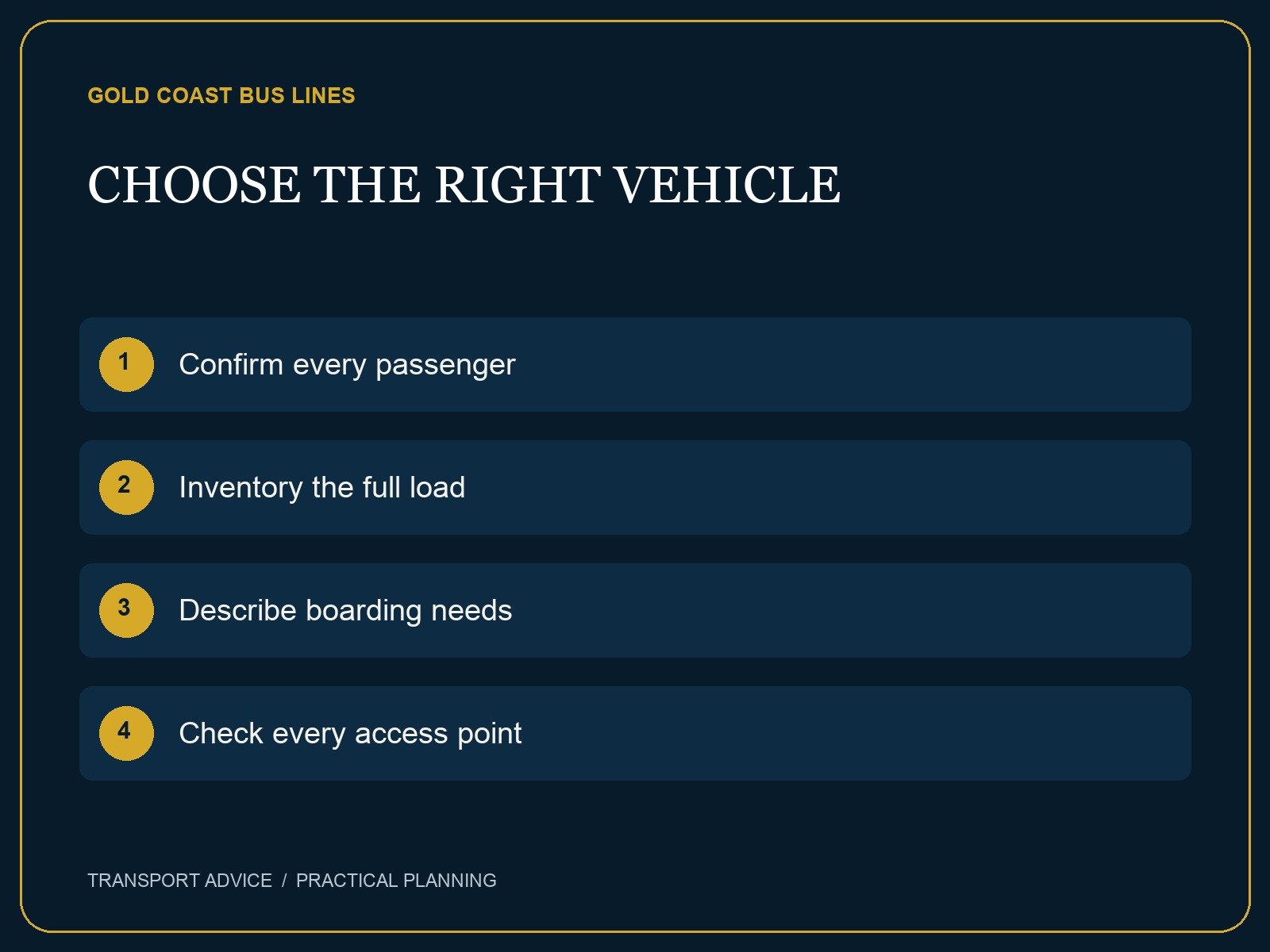
Count everyone who needs to travel
Include organisers, teachers, support people, children and any additional passengers joining later. State adult and child numbers and flag any child-restraint needs for the operator to assess against the actual service and vehicle. Do not assume that a small child can be omitted from the booking count.
Count each movement separately when the group changes. A speaker joining for dinner or guests taking an early return can alter the busiest departure. The vehicle plan should meet the peak allocation, not just the first number mentioned in the enquiry.
If attendance is uncertain, provide a likely count and a realistic maximum. Ask how that range affects the proposed vehicle and what deadline applies to final confirmation. A vague “around 30, maybe more” is less useful than a stated range and a known decision date.
Build a full luggage and equipment inventory
Separate large suitcases, cabin cases, soft bags and unusual items. Ask whether golf clubs are inside rigid travel cases, whether prams fold and whether mobility equipment needs to travel assembled. Include the items organisers sometimes forget, such as banners, presentation materials, team kits and eskies.
Give dimensions and approximate weights for bulky or heavy pieces when available. Photographs can help explain shape, but they do not replace measurements. Send this information through the booking contact rather than assuming a website photograph shows the exact storage configuration being offered.
| Item type | Useful description | Additional question |
|---|---|---|
| Suitcases | Count and approximate size | Do they travel on every leg? |
| Golf equipment | Bags, rigid cases and buggies | Can cases be stored elsewhere? |
| Prams | Folded dimensions and count | When must they be accessible? |
| Mobility aids | Type, dimensions and travel requirement | Does the passenger remain in the device? |
| Event equipment | Shape, size and approximate weight | Is separate carriage required? |
Keep the list current. A group that switches from a day outing to hotel checkout has changed its load even if no passengers are added. Advise the operator before the service so any revised arrangement can be assessed.
Treat usable seating and storage as separate checks
A vehicle category describes seating, but the specific arrangement determines what can travel safely with passengers. Ask the operator to confirm both the passenger allocation and the luggage inventory in the accepted booking. Do not use an assumed “one large bag per seat” rule unless the provider has confirmed it for the vehicle.
Spare seats are not a luggage plan. Bags and equipment need appropriate stowage, with aisles, exits and passenger space kept clear. Let the operator decide the safe loading arrangement rather than asking passengers to hold large items throughout the trip.
If a trailer is proposed, review it as part of the vehicle combination. It can affect turning, parking and permitted access. The cruise transfer guide gives a terminal-specific example where trailer access differs from ordinary passenger-car collection.
Describe boarding and accessibility needs clearly
Explain what passengers need to board and travel comfortably. Useful information includes whether someone can manage steps, needs additional boarding time, uses a folding aid or must remain in a wheelchair. The operator can then confirm suitability and any specific equipment or space requirements.
Avoid relying on broad descriptions such as “elderly group” or “accessible venue”. People have different needs, and a step-free destination does not establish that the proposed vehicle provides suitable boarding. Confirm the journey from the original assembly point through to the destination entrance.
Where the proposed arrangement cannot meet a need, ask about an appropriate alternative before booking. Do not present the website’s fleet range as proof that every accessibility requirement can be fulfilled. The final confirmation should be specific to the passenger and service.
Check the route and the tightest access point
Provide every hotel, venue and planned stop. Include the venue’s nominated vehicle entrance, turning instructions and any known restrictions. A vehicle that suits the main road journey may not suit a private driveway or the intended loading area.
The tightest confirmed access point can govern the whole choice. Options might include another approved loading point, a different stop or a suitable alternative vehicle arrangement. Assess those changes with the operator and venue rather than assuming a smaller vehicle solves every problem.
Use the coach access guide for general planning and the Tamborine and hinterland guide for mountain trips. Route suitability and current conditions need operator assessment; a passenger-car navigation route is not sufficient confirmation.
Use the fleet range as a shortlist
The site includes executive sedans and 7–8 seater premium people movers for discussing smaller groups, alongside 15-seater, 24-seater, 33-seater, 40-seater, 50-seater and 57-seater categories. Choose a shortlist based on the full brief rather than treating the labels as interchangeable offers.
For an executive movement, luggage can still be decisive. A small number of passengers with large cases may need a different arrangement from the same people travelling to dinner. For a larger group, usable capacity and access may make a combination of sizes more suitable than the biggest category alone.
Ask which vehicle features are confirmed for the proposed service. Do not infer onboard facilities, storage volumes or a particular model from an illustrative image. If a feature matters to the trip, include it as a requirement and obtain a clear response.
Worked scenario: the same 20 passengers, three different trips
First, imagine 20 delegates travelling from a hotel to a local meeting with small personal bags. Second, the same 20 people check out and travel with large suitcases. Third, 20 golfers travel with clubs, rigid cases and overnight bags. The seating requirement begins at the same number, but the storage and loading assessment changes each time.
The organiser sends a separate inventory for each scenario. The operator may propose different vehicle arrangements or explain the limitations of one option. The decision is based on confirmed suitability rather than assuming a single passenger count always leads to a single vehicle category.
If the group wants one vehicle across several days, assess it against the most demanding load and every venue. A vehicle suitable for the lightest day does not automatically cover the airport arrival or final checkout movement.
Decide what must stay available during stops
Some belongings can remain stowed until the destination; others are needed during the day. Ask passengers to keep medication, identification, tickets and essential personal items with them. Tell the operator if equipment must be unloaded and reloaded at several stops.
If passengers expect access to stored bags during an event, confirm whether the vehicle remains available and where it waits. A transfer booking may release the vehicle after set-down. An event venue may also require it to park away from the entrance.
For equipment-heavy programmes, consider whether passenger transport is the right place for every item. Ask about the proposed carriage arrangement without assuming the provider offers freight or specialist equipment transport. A separate confirmed solution may simplify the passenger movement.
Confirm the arrangement, then control changes
The accepted booking should reflect passenger numbers, load, access and any essential vehicle features. Keep a record of what was confirmed and identify anything still pending. If the proposed vehicle changes, check that the replacement meets the same requirements.
Tell passengers what luggage has been allowed for and ask them to report changes. An extra rigid case or large piece of equipment may affect the plan even when a spare passenger seat remains. Do not leave those changes until loading begins.
For multiple vehicles, assign both people and belongings. The combined fleet may have enough capacity while one allocated vehicle does not. Review each load separately and avoid unnecessary transfers of luggage between vehicles during the itinerary.
Send a brief the operator can assess
Provide date, movement times, passenger count by leg, luggage inventory, unusual-item dimensions, boarding needs and all addresses. Add venue instructions and distinguish essential vehicle requirements from preferences. If you have flexibility, say where it lies: vehicle type, departure window or an optional stop.
Use private group transport or the relevant service page, then request a quote with the complete load. The quote information guide provides a reusable structure for the enquiry.
Frequently asked questions
Should we book the smallest vehicle with enough seats?
Only if it also suits luggage, equipment, boarding needs, access and the timetable. Seat count is a starting point; ask the operator to confirm the complete arrangement.
Can luggage go on empty passenger seats?
Do not plan around that assumption. The operator needs to assess appropriate stowage and keep passenger space, aisles and exits clear. Provide the load in advance so a suitable solution can be confirmed.
Is a trailer always available for extra luggage?
No. Availability and suitability depend on the service and route. A trailer can also change access requirements, so it must be included in the confirmed vehicle plan.
What if our luggage changes after booking?
Notify the provider promptly with the revised inventory. Ask whether the existing arrangement remains suitable or needs adjustment, and obtain confirmation before travel.