
A useful bus quote request does not need to be long, but it does need to describe the trip. “Thirty people, Gold Coast, Saturday” leaves the provider guessing about the date, vehicle load, distance, timing, access and return. Those assumptions can lead to repeated questions or a proposal that does not match what the group expects.
Prepare one clear brief, even if parts of the event are still being decided. Give confirmed information, label provisional details and identify the choices you want help with. This article focuses on the enquiry itself; the existing bus hire pricing guide explains how to compare the resulting prices and inclusions.
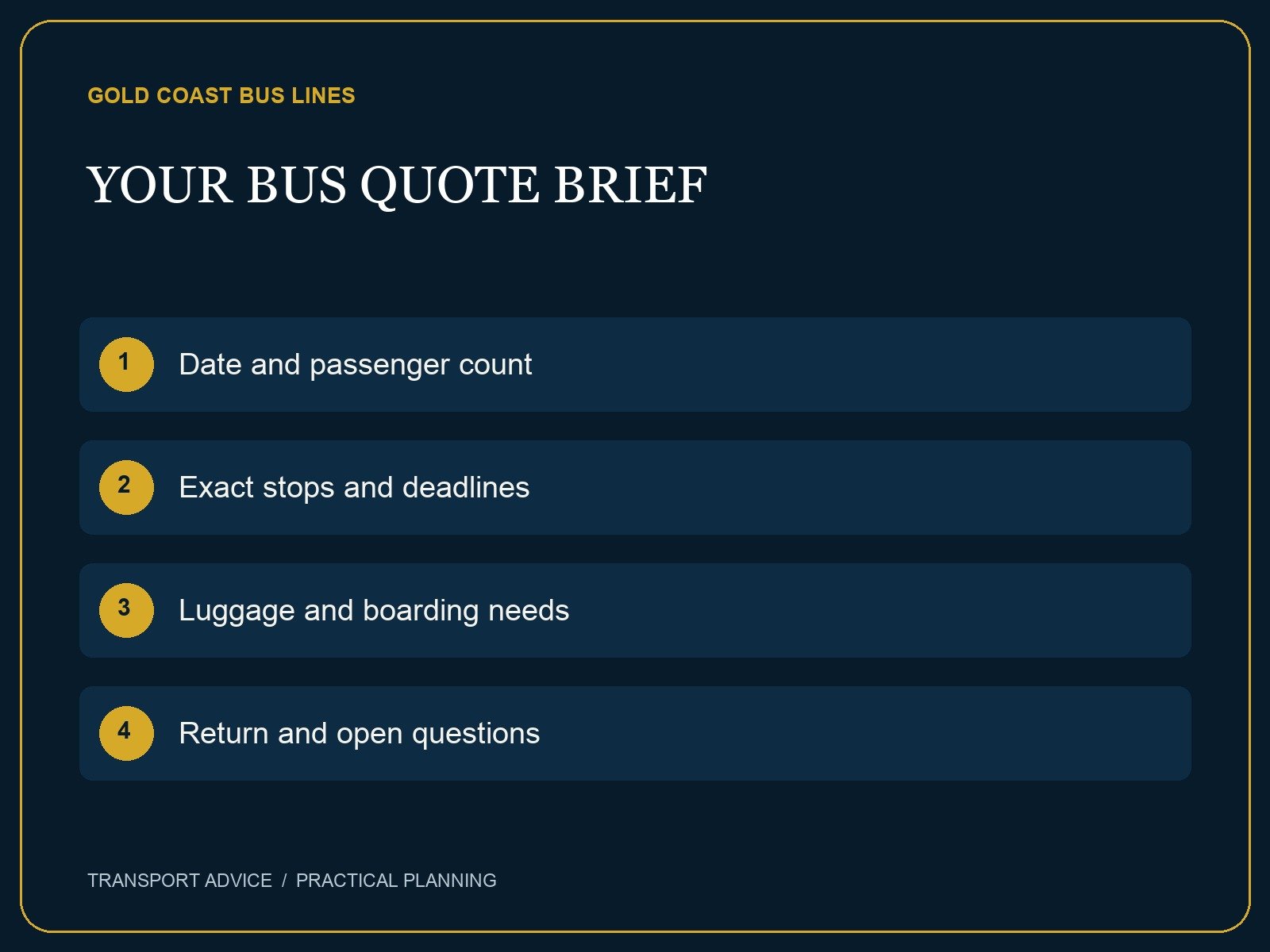
Start with the date and purpose
Write the full travel date, including the year, and identify every day if the programme spans more than one. For an overnight return, make the date change explicit. A late event finishing after midnight belongs to the next calendar day even if guests think of it as the same evening.
Describe the purpose in a sentence: conference delegates, wedding guests, a school excursion, a golf group or a private outing. The purpose helps explain likely timing and equipment, but it does not replace the actual requirements. A wedding can be a single transfer or several staged returns.
If the date is flexible, give the acceptable options rather than asking for an undefined “best day”. If it is fixed, say so. That allows the operator to assess the real request and avoids spending time on alternatives the organiser cannot accept.
Count passengers for each movement
State the total number of people travelling, including organisers and support people. Where useful, break down adults and children and flag any restraint or supervision requirements for discussion. Do not omit someone because they are travelling only on the return.
For changing groups, provide a count per leg. A conference might move 40 people to the venue, 46 to dinner with partners and 32 back to the original hotel. Those differences belong in the first brief, not in a note added after the vehicle has been selected.
If attendance is not final, give a likely number and a credible upper limit. Tell the provider when it will be confirmed. Ask whether the range changes the recommended vehicle plan and what happens if it rises after acceptance.
Give exact locations and access instructions
List property names, street addresses and the entrance or loading point if known. A suburb is useful context but not enough to assess a route. Different entrances at the same venue can have very different access for a bus or coach.
Ask the venue or hotel for its transport instructions and share them with the provider. Include height, turning or waiting restrictions you have been told about, without guessing at missing measurements. Mark access as unconfirmed if the venue has not yet answered.
For several hotel pickups, allocate passengers to each stop. Use the multiple-pickup guide to prepare the sequence for assessment. Let the operator review the best order rather than insisting on the order in which the organiser happened to write the addresses.
Distinguish arrival requirements from proposed departures
Tell the provider when passengers must be ready at the destination. If registration closes at a certain time or a ceremony begins promptly, say that. The bus needs to arrive early enough for unloading and walking before the group reaches that deadline.
If you also propose a departure, label it as a preference unless it is fixed. Asking for an early arrival and a late departure from the origin can create an impossible schedule. The provider should be able to assess the timing rather than interpret both as promises it must somehow satisfy.
For travel across the Queensland–NSW border, label times by state. The Byron Bay transport guide explains the daylight-saving issue. For flights and cruises, provide the relevant booking identifiers and required arrival guidance rather than deriving a transfer time from the headline schedule alone.
List the full load and boarding needs
Count suitcases, cabin bags, golf equipment, prams, mobility aids and event materials. Include dimensions or photographs for unusual items through the agreed booking channel. “Normal luggage” has no consistent meaning across a day excursion, a cruise group and a multi-day sports trip.
Describe boarding requirements in practical terms: difficulty with steps, remaining in a wheelchair, extra boarding time or other assistance needs. Ask the operator to confirm a suitable arrangement before the booking is accepted. Avoid assuming that a particular seating category implies a particular accessibility feature.
The vehicle-selection guide gives a more detailed inventory. Use the fleet hub to discuss options, but let the complete load and access determine suitability rather than selecting solely on seats.
Include returns, waiting and optional movements
Give the return date, assembly location, expected departure and all final destinations. If some guests leave early or stay behind, provide their allocations. An outbound quote request should not silently imply unlimited later collections.
Explain whether the vehicle must remain available between movements. Tell the provider if passengers need access to bags or equipment during the event. If the finish is uncertain, give a realistic window and ask how waiting or a revised departure would be handled.
Separate optional stops from confirmed work. An optional restaurant transfer or sightseeing visit can be assessed as an alternative, but it should not appear as a definite passenger instruction until accepted. The pricing guide explains why that scope affects transfer and charter comparisons.
Use a simple movement table
For more than one journey, use one row per movement. Keep the same identifiers throughout the enquiry and later schedule. A clear table is easier to review than a long paragraph in which the return date, extra hotel and flight details are buried.
| Field | What to supply |
|---|---|
| Movement ID | Outbound, dinner transfer, early return or another clear label |
| Date | Full date for that specific leg |
| People | Count and any groups that must stay together |
| From and to | Exact properties, addresses and access notes |
| Timing | Required arrival, proposed departure and flexibility |
| Load | Bags and equipment on that leg |
| Contact | Organiser and relevant venue contact |
| Status | Confirmed details and open decisions |
If the schedule is complex, attach or supply it through the provider’s agreed channel and summarise the purpose in the enquiry. Do not rely on the operator to reconstruct the itinerary from several unrelated email chains or screenshots.
A reusable enquiry template
Copy the fields below into your enquiry and replace the bracketed notes. They are prompts, not a sample confirmed booking. If a detail is unknown, write “to be confirmed” and say when you expect an answer.
Trip purpose: [one sentence]. Travel date(s): [full dates]. Passengers: [count by movement, including organisers]. Pickup(s): [property, full address, people per stop and known loading instructions]. Destination(s): [property, address and entrance]. Required arrival: [time, date and time zone where relevant]. Preferred departure: [time or ask the operator to recommend]. Return: [date, time/window, loading point and final stops]. Luggage/equipment: [itemised count and unusual dimensions]. Boarding/accessibility needs: [practical requirements for assessment]. Vehicle availability between movements: [required or not required]. Optional stops: [clearly separated]. Organiser contact: [name and contact details]. Open decisions: [items and expected confirmation dates].
For budget discussions, you can also state a target and identify genuine flexibility. That does not replace the itinerary or guarantee that a suitable service fits the target, but it gives the operator context for assessing alternatives.
Worked example: a business group with a dinner return
Imagine 34 delegates travelling from two hotels to a conference, then on to dinner. Six additional guests join the dinner, and four delegates remain elsewhere afterwards. The request should show 34 to the conference, 40 to dinner if all delegates attend, and 36 on the final return.
The organiser lists each hotel’s allocation, the venue entrance and the time people must be inside registration. The dinner location supplies its own loading instructions. Final hotel counts are recorded separately because the return population differs from the morning group.
If delegates check out that morning, the luggage inventory changes the vehicle assessment. The organiser states whether suitcases travel all day and whether access to them is needed. This turns a vague “conference bus” request into a movement plan that can be reviewed and priced.
Check the reply against the same brief
When the quote arrives, confirm that it covers the itinerary version you sent. Look for passenger and luggage assumptions, vehicle arrangement, stops, timing, waiting, returns and any unresolved access questions. Ask for clarification if the proposal differs from the request.
Review payment, change and cancellation terms supplied with the booking, as well as the stated inclusions. A quote is not necessarily a confirmed vehicle reservation. Ask what acceptance or payment process applies and obtain the provider’s confirmation before telling passengers the service is booked.
Keep the accepted proposal with the current schedule. If a detail changes, send a clearly marked revision and ask the provider to confirm any effect on suitability or price. Retire old passenger instructions so guests do not follow a superseded time.
Send the request through the right pathway
Choose the relevant service and Gold Coast location where helpful, then use the quote page. The enquiry form may collect the basic fields; place the full itinerary and remaining requirements in the appropriate notes or agreed follow-up channel.
Share only the passenger information necessary for planning. A transport quote generally needs counts, movement details and relevant assistance requirements, not a public list of identity documents or unrelated personal information. The organiser can maintain attendance records separately and share operational details as needed.
Frequently asked questions
Can I request a quote before all details are final?
Yes. Label provisional information, provide a realistic range and identify fixed deadlines. Ask which details must be settled before the provider can confirm the vehicle and price.
Do I need to choose the exact bus first?
No. Supply passenger, load and access requirements so the operator can recommend a suitable arrangement. A preferred category can be included, but it should not replace the full brief.
Should I include a return if its time is uncertain?
Yes. Give the likely window and explain the uncertainty. Ask how waiting and changes would be handled rather than omitting the return or assuming it can be arranged later.
What is the most useful detail organisers forget?
Often it is the required arrival inside the venue, the full luggage load or a changed return count. Check all three before sending, along with exact loading locations.