
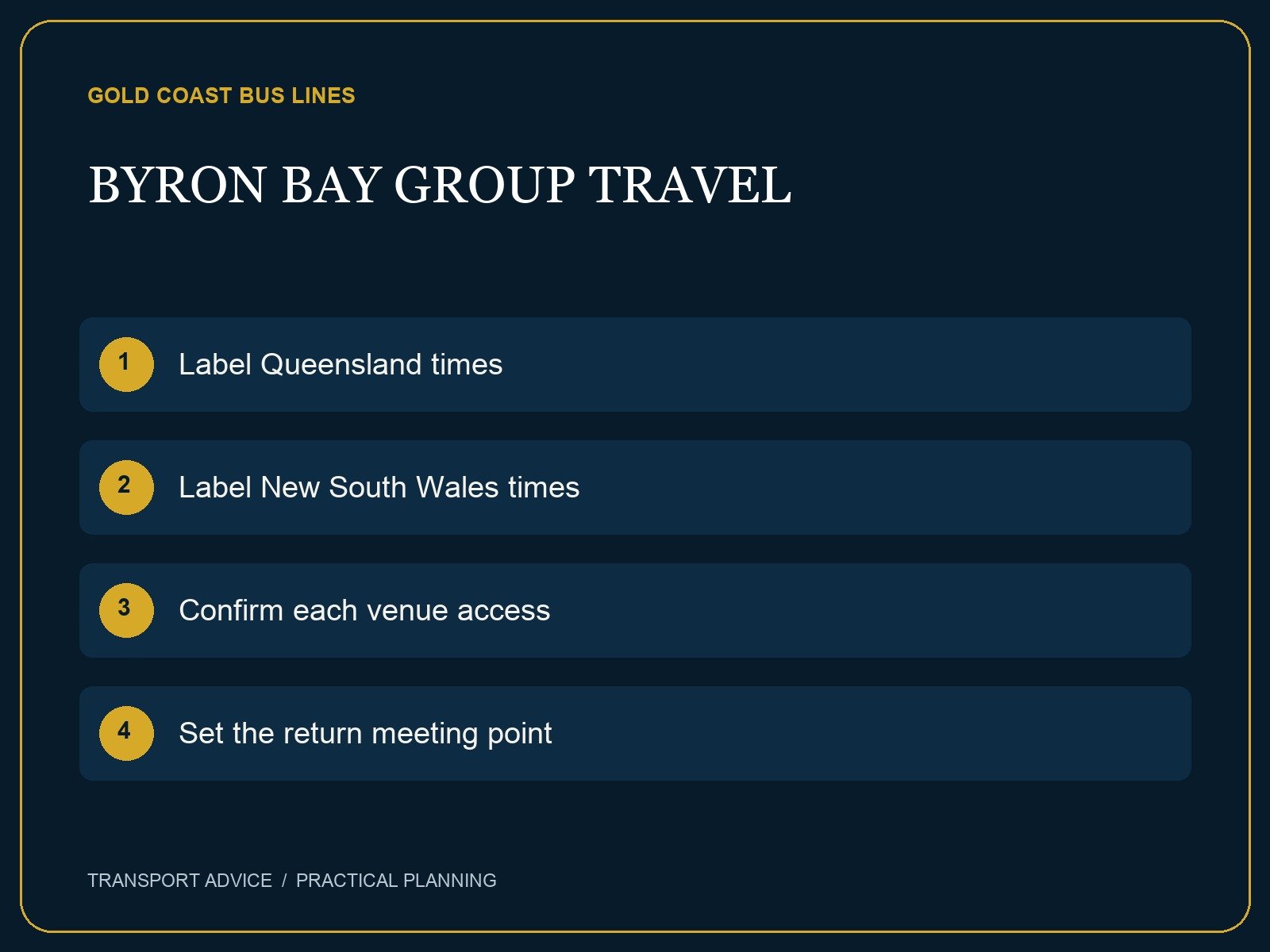
A Gold Coast to Byron Bay outing can look simple on a map and become complicated on the day. Passengers may start at several hotels, a lunch reservation may use a different local time, and the intended collection point may not suit the vehicle. Planning these details before booking is more useful than collecting a list of attractions and hoping the route fits.
This guide is for private groups travelling together: friends, retreat attendees, wedding guests, business groups or leisure visitors. It focuses on building a workable day or overnight transfer. Vehicle availability, access and the final timetable need to be confirmed against the actual itinerary rather than assumed from a general route description.
Put the date and time zone on every movement
Queensland does not observe daylight saving, while New South Wales does. During the NSW daylight-saving period, Byron Bay is one hour ahead of the Gold Coast. Outside that period, the clocks align. Check the travel date using the NSW Government’s time information before distributing the itinerary.
Write “Queensland time” beside Gold Coast pickups and “NSW local time” beside Byron Bay bookings and returns. A message saying only “depart at four” can be misunderstood, especially when phones automatically update after crossing the border. Use the same wording in passenger messages, venue confirmations and the operator’s schedule.
For illustration, in daylight-saving months a 9:00 am Queensland departure followed by a hypothetical 90-minute journey would reach NSW at noon local time, not 10:30 am. The 90 minutes is an arithmetic example, not a route estimate. Reverse the clock adjustment when explaining the return arrival in Queensland.
Define what the group is actually booking
Separate a direct transfer from a day charter with stops. A one-way movement to Byron accommodation is different from a day that includes sightseeing, lunch, free time and an evening return. List every location where the group needs to board, leave the vehicle or retrieve belongings.
If the group wants flexibility, describe its boundaries. “Lunch may finish between two and three, then return directly” gives the operator something to assess. “We will decide everything on the day” leaves venue access, driver time and the return uncertain. Use the pricing guide’s transfer and charter comparison to understand the different booking structures.
For an overnight trip, specify whether transport is needed only at the start and end or also between accommodation, restaurants and activities. A vehicle that delivers the group should not be assumed to remain available overnight. Each additional movement needs to be included in the accepted plan.
Build the day around one or two fixed commitments
Choose the commitments that cannot move, such as accommodation check-in arrangements, a wedding arrival or a booked group meal. Work backwards from those deadlines. Add road travel, the effect of multiple pickups, unloading, walking and the time-zone adjustment as separate steps.
Avoid packing the schedule with stops that each appear “only ten minutes away”. For a group, every stop includes gathering passengers, boarding, checking attendance, manoeuvring and finding an appropriate loading place. Three short visits can consume much more of the day than the driving distances suggest.
| Trip element | Decision to settle | Common planning trap |
|---|---|---|
| Gold Coast departure | Exact meeting point and Queensland time | Treating hotel checkout as boarding time |
| First NSW booking | Required arrival in NSW local time | Applying the wrong clock |
| Leisure stops | Priority, duration and approved access | Assuming every landmark accepts coaches |
| Lunch or event | Booking time and group readiness | Ignoring walking and seating time |
| Return | Meeting point, assembly and departure | Sending guests only a vague suburb name |
Ask the operator for a realistic assessment of the route on the intended date. Check current road information through QLDTraffic and Live Traffic NSW when finalising travel. Road conditions and event impacts should be reviewed again close to departure.
Confirm Byron Bay access before choosing the vehicle
Give the operator the venue’s transport instructions and a contact who knows the entrance. Accommodation driveways, private properties and visitor locations can have turning or height constraints. A street address alone does not establish coach suitability, and access for a passenger car does not demonstrate access for a bus.
For public areas, use current council information and signs; Byron Shire Council’s parking guidance is a starting point. A marked public bus facility should not be treated as a guaranteed private charter waiting area. Ask the operator to confirm the correct arrangement for the vehicle and intended stop.
If a desired visit involves a narrow approach, limited parking or a walk from the drop-off point, assess that before promising it to guests. Provide an alternative activity or meeting point in the draft plan. Do not ask the driver to improvise access because an attraction was advertised on the invitation.
Choose pickups that fit the southbound trip
A group spread across the Gold Coast may need hotel pickups, a central assembly point or two smaller feeder movements. Passengers staying in Coolangatta will not necessarily benefit from first travelling north to join a bus. Equally, visiting every accommodation address can create a long first-to-last pickup period.
Give each stop a passenger allocation and a person responsible for attendance. Use the pickup guide to distinguish meeting time from vehicle departure. Tell guests to have bags ready before the bus arrives; loading time is part of the itinerary, not spare time for finishing checkout.
If the group consolidates at one place, confirm that passengers may wait there and that arriving cars will not block the coach. A convenient map pin is not enough. Consider shade, shelter, walking distance and how people with mobility needs will reach the loading point.
Count bags, equipment and accessibility needs
Day visitors, wedding guests and retreat groups often have very different storage requirements. Count suitcases, overnight bags, prams, mobility aids and bulky activity equipment separately. Provide dimensions or photographs for unusual items through an agreed contact channel. Avoid relying on “one bag each” when some bags are hard suitcases and others are small backpacks.
A 24-seater minibus may be one option to discuss for a medium group, but the actual vehicle must suit the combined load and route. Compare the fleet with the vehicle-selection guide before deciding solely by passenger numbers.
Discuss boarding requirements in practical terms. Let the operator know if a person cannot manage steps, needs to remain in a wheelchair or requires more time to board. Confirm suitability before accepting the booking. Do not assume that a vehicle shown online has every accessibility feature.
Make the return easy to find
Use one written return instruction with the place name, exact meeting point, NSW local time, organiser contact and departure time. If the return location differs from the morning drop-off, tell passengers explicitly. A photograph or agreed landmark can help, but should accompany a verified loading location rather than replace one.
Set a procedure for people who wish to remain in Byron Bay. They should notify the organiser before the final count, so the vehicle does not wait for somebody who has made other plans. Confirm whether the return passenger count differs and whether luggage remains onboard for people not travelling back.
Agree how changes will be handled if lunch runs late or the weather alters an activity. The organiser should contact the operator before extending the schedule. Additional waiting or a later finish may affect availability and price, and the driver’s operating requirements still apply.
Worked scenario: a retreat group checking out
Imagine 22 guests leaving two Gold Coast hotels for a Byron-area retreat. Everyone has an overnight case, and the retreat asks for arrival after a specified local time. The organiser initially requests a sightseeing stop but has not checked where the luggage would stay or whether the vehicle can enter the chosen location.
A better brief gives the hotel allocations, item count, retreat entrance instructions and NSW arrival window. The sightseeing stop is marked optional, with permission to omit it if access or timing does not work. The operator assesses storage and route suitability before the group commits to a vehicle category.
For the return two days later, the organiser sends a separate schedule. Guests assemble with bags before the departure time, one contact checks attendance, and Queensland arrival expectations use the correct clock. The quote covers the agreed movements instead of implying that the bus stays at the retreat throughout.
What to send with the enquiry
Include travel date, number of adults and children, each Gold Coast pickup, every NSW stop, required arrival times with time zones, return schedule and luggage inventory. Add venue contacts and any pending access decisions. Identify optional stops so the operator can explain the effect of including or removing them.
Use private group transport for a shared transfer or discuss tour bus hire for a structured itinerary. When ready, request a quote with the full plan and make clear which details are still provisional.
Frequently asked questions
Is Byron Bay always one hour ahead of the Gold Coast?
No. The difference applies during NSW daylight saving. Check the travel date and label times by state on the itinerary, even when both places currently show the same time.
Can we add a landmark visit on the day?
Ask before travel wherever possible. The operator needs to assess access, parking, time and the effect on later bookings. An unplanned stop is not automatically included or feasible.
Can the bus carry our luggage while we explore?
Confirm storage capacity and the vehicle’s availability during the stop. Keep anything needed during the visit with you. Do not assume access to stored bags while the vehicle is parked away from the group.
Should we book a transfer or a day charter?
A defined one-way or return movement may suit transfer pricing. Several stops or a vehicle committed across the day may call for a charter arrangement. Compare the full operating scope in the existing pricing guide.