
A cruise transfer has a deadline, a substantial luggage load and a terminal process outside the transport provider’s control. The outbound trip must fit the cruise line’s arrival instructions. The return must allow for passengers actually leaving the ship, collecting bags and reaching the agreed meeting point. Neither movement should be scheduled from the ship’s headline timetable alone.
This guide covers Gold Coast groups travelling to a cruise terminal, especially Brisbane International Cruise Terminal, and groups returning to accommodation or airports. Confirm the terminal for the specific sailing, then prepare the passenger, luggage and timing information needed to assess the journey.
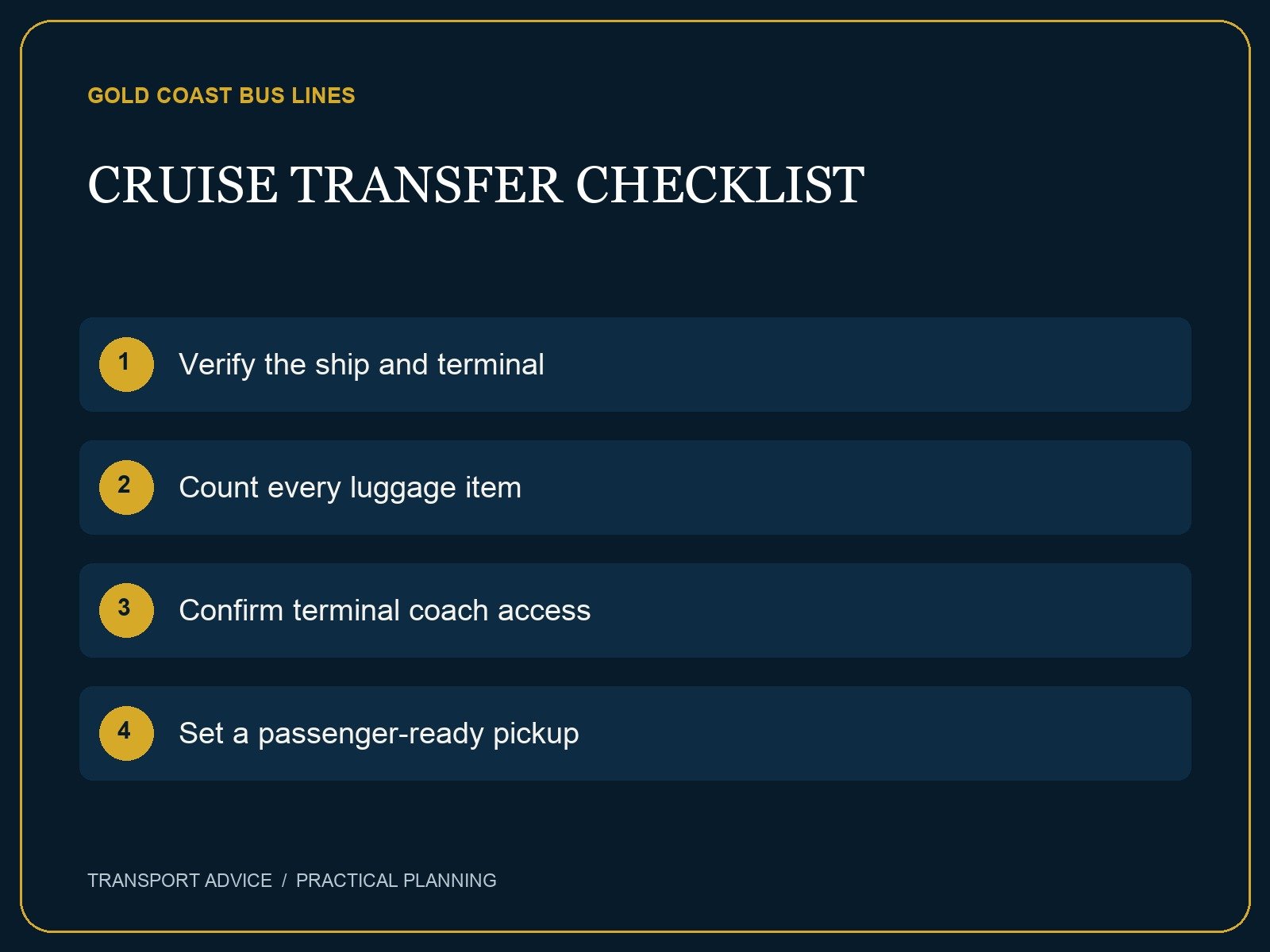
Verify the terminal from the cruise booking
Record the cruise line, ship, sailing date and terminal named in the passenger documents. Do not book from a remembered address or a search for “Brisbane port”. The Port of Brisbane’s current directions place Brisbane International Cruise Terminal at 1 Cruise Terminal Drive, Pinkenba. Use the cruise documents to confirm that this is the correct destination for the sailing.
Give the operator the terminal details with the required arrival window, not just the ship’s departure time. If the cruise line changes the instructions, pass them on promptly and obtain confirmation of any transport amendment. A forwarded email is useful evidence, but it is not by itself an accepted change to the vehicle schedule.
For a party using several bookings, compare arrival instructions across the group. Ask the cruise line how the group should coordinate if passengers have different assigned windows. The transport provider cannot override the terminal’s check-in process.
Work backwards from the boarding process
Start with the arrival window and latest check-in requirements supplied by the cruise line. Then allow for terminal approach, unloading passengers and bags, and any walk to the relevant entrance. Ask the operator to assess road travel and contingency for the actual Gold Coast pickups.
Do not plan to arrive at the last permissible moment. Equally, arriving far before the assigned window may create unnecessary waiting. The cruise line determines the appropriate arrival process; the transport schedule should support it rather than invent a universal “arrive three hours early” rule.
| Planning input | Obtain it from | Why the operator needs it |
|---|---|---|
| Ship and terminal | Cruise confirmation | Correct destination and sailing |
| Arrival window | Cruise line | Workable departure planning |
| Passenger count | Group organiser | Confirmed seating requirement |
| Luggage inventory | Every travelling party | Storage and loading assessment |
| Terminal instructions | Current port and operator arrangements | Appropriate vehicle access |
| Return readiness | Cruise line guidance plus group plan | Realistic collection window |
If passengers fly in before the cruise, assess that connection separately. Flight delays, baggage collection and the onward road trip all sit between the scheduled landing and terminal arrival. The airport group transfer guide helps build that part of the brief; the cruise line or travel adviser should confirm the suitability of the overall connection.
Count luggage by type, not by household
Ask each travelling party for large suitcases, smaller cases, cabin bags, prams and mobility equipment. A household may report “two bags” while referring only to checked luggage, leaving several cabin bags uncounted. Record the whole load, including items passengers expect to keep near them.
Provide dimensions for unusually large or rigid items. A group of 30 passengers with cruise luggage is not necessarily suited to the same vehicle as 30 people attending a short local event. Use the fleet as a discussion point, then obtain confirmation of storage for the specific vehicle and itinerary.
Do not allocate spare seats as luggage space or plan to stack bags in aisles. The operator must assess safe loading and access. If a trailer or another storage arrangement is proposed, confirm that it fits terminal access as well as hotel pickups. See choosing a bus for passengers and luggage for a fuller checklist.
Confirm coach access instead of using a car pickup plan
Brisbane International Cruise Terminal distinguishes the passenger drop-off loop from its Coach & Shuttle Area. Current port access guidance says vehicles longer than 6.5 metres and vehicles with trailers must use the coach area, and chartered connections need prior agreement. Ask the operator to confirm the relevant arrangement before travel.
This means a pickup instruction intended for a private car may be unsuitable for the booked vehicle. Give passengers the meeting instructions confirmed for their transfer. Do not substitute a taxi rank, rideshare point or a convenient-looking entrance because it appears closer on a map.
For passengers needing assistance, coordinate the transport arrangement with the cruise line’s assistance process. A suitable vehicle is only one part of the journey. Confirm how the passenger moves between the loading point, terminal and ship, including any equipment that must remain with them.
Make the Gold Coast pickup ready for luggage
Hotel pickups need a place for the group to assemble with bags before the vehicle arrives. Tell reception the agreed arrangement where appropriate, and check whether all passengers can wait without obstructing the entrance. Guests should complete checkout before the assembly time.
With several hotels, provide a passenger and luggage allocation for each stop. The first group’s bags may need to be loaded with later unloading in mind. Let the driver direct loading, while the organiser checks people and labels against the list.
The multiple-pickup planning guide helps prevent a long hotel circuit from consuming the arrival buffer. A group in Main Beach and another elsewhere on the Coast may need a different route from a party staying at adjacent properties.
Plan the return around passengers being ready
The ship’s scheduled arrival is not a guaranteed roadside pickup time. Disembarkation sequence, luggage collection and terminal processing affect when the group can assemble. Ask the cruise line about its process and agree a practical collection arrangement with the transport provider.
Choose a lead passenger who can communicate after leaving the ship. Agree what counts as “ready”: for example, everyone in the transfer group has collected their bags and reached the nominated assembly point. A message from the first person off the ship should not trigger a vehicle arrival if most of the group is still inside.
The port’s cruise FAQs explain that embarkation and disembarkation processes vary by cruise line. They also state that the terminal has no luggage lockers. If the group plans a later activity before transport, confirm a workable luggage arrangement rather than assuming storage is available onsite.
Separate onward destinations and deadlines
Some passengers may return to Gold Coast accommodation, others to Brisbane Airport, and others to a private address. Record each destination and the corresponding count. Combining them in one vehicle can create a route that is inconvenient or unsuitable for an onward deadline.
For airport-bound passengers, provide flight numbers and check-in requirements. Do not guarantee a connection from a generic estimate of disembarkation. The cruise line, airline or travel adviser should help assess the connection, and the operator should assess the road movement within it.
If different groups have materially different deadlines, compare separate vehicles. The one bus or multiple buses guide shows how independent movements can avoid making every passenger follow the most complicated route.
Worked scenario: 36 guests and mixed returns
Imagine 36 guests leaving three Gold Coast hotels for the same sailing. Their combined load includes 36 large cases, cabin bags and two mobility aids. The organiser sends those details before selecting a vehicle. The operator confirms storage, hotel access and the terminal coach arrangement against the arrival window.
On return, 10 guests travel to Brisbane Airport and 26 return to the Gold Coast. The organiser asks for the two movements to be assessed separately instead of assuming one loop. Each has its own contact, luggage allocation and readiness procedure.
Passengers receive the appropriate return message before the cruise ends. The group leads confirm readiness after luggage collection, and changes go through the booking contact. This reduces the risk of one subgroup waiting for another with an unrelated destination or later disembarkation.
Agree waiting and change arrangements in advance
Ask how the booking handles delayed disembarkation, a changed terminal instruction or passengers missing from the assembly point. Clarify included waiting, additional time and how vehicle availability is managed. These are booking-specific terms, not guarantees that should be inferred from a return-transfer label.
Keep identification, medications, cruise documents and essential items with passengers rather than in inaccessible luggage. Ask the cruise line what must be kept available during check-in. The organiser should not collect sensitive document copies merely to make a transport manifest.
Use private group transport for the cruise movement and airport transfers for connected flights. Request a quote with the ship details, full load and separate outbound and return schedules, marking any unresolved information clearly.
Frequently asked questions
Should collection be booked for the ship’s arrival time?
No. Agree a passenger-ready collection plan that allows for disembarkation, luggage and terminal processing. The scheduled berth time alone does not establish when the group will be outside.
Can a minibus with a trailer use the normal drop-off loop?
The current Brisbane terminal guidance directs vehicles with trailers to the Coach & Shuttle Area. The operator must confirm the applicable access and prior arrangements for the booked service.
Is cruise luggage included automatically in the seat count?
No. Provide the number and type of all bags and equipment. Seating and storage are separate checks, and the operator must confirm the actual vehicle arrangement.
Can we combine airport and Gold Coast returns?
Ask for the full route to be assessed against every onward deadline. Separate vehicles may be more practical when destinations, luggage or readiness times differ substantially.