
Conference transport has several different peaks: arrivals from airports, morning hotel departures, evening functions and the final exodus with luggage. Treating them as one daily shuttle can hide the most demanding movement. A morning run carrying delegates with laptops may need a different storage plan when those same delegates check out with suitcases.
Start with a movement schedule linked to the event programme. Give every journey a date, passenger group, origin, destination, required arrival and return arrangement. The general event transport guide explains the overall planning process; this article goes deeper into delegate allocations, registration deadlines and multi-day conference changes.
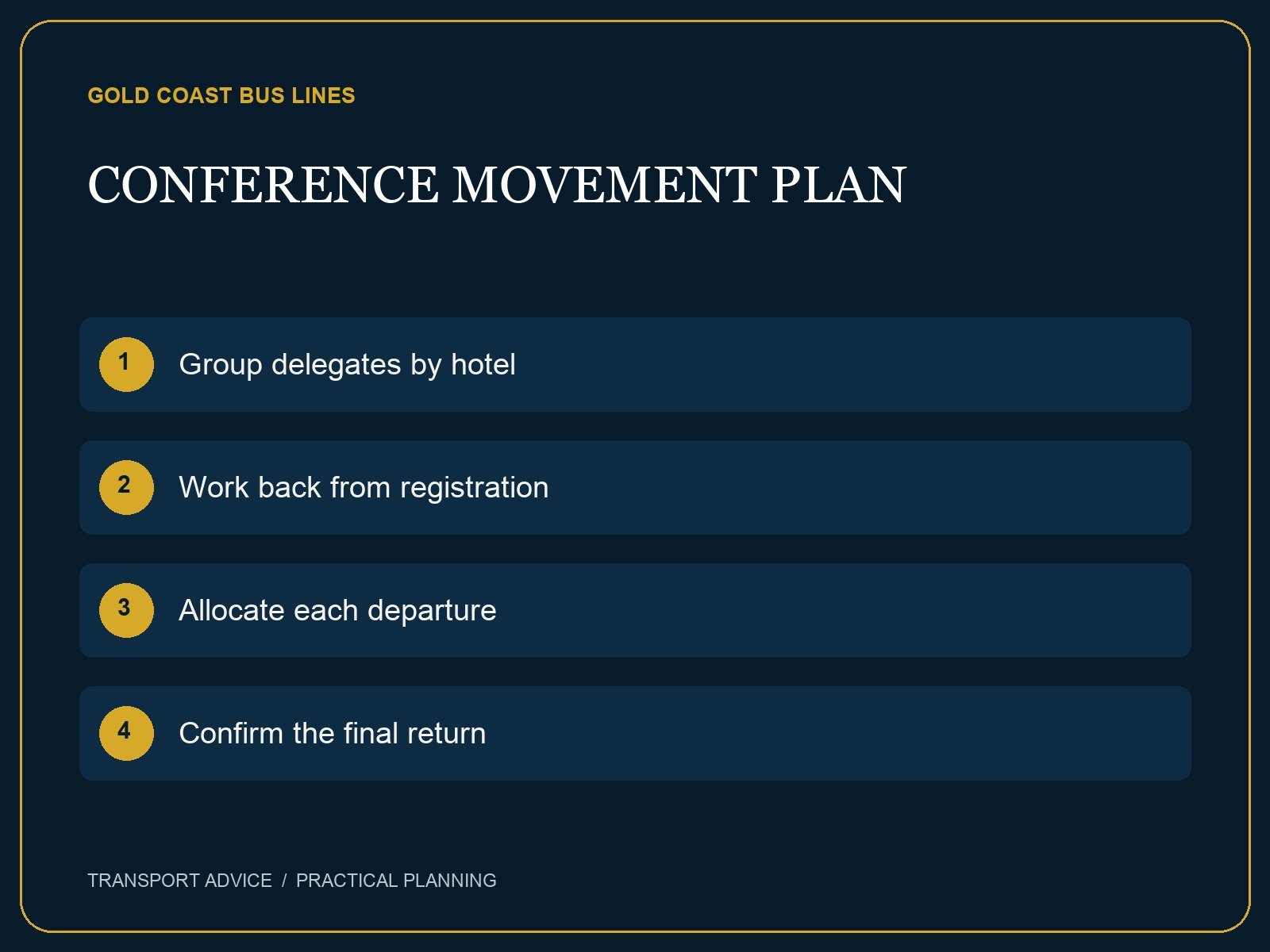
Translate the programme into transport deadlines
A session starting at 9:00 am does not mean a coach should arrive at 9:00 am. Work backwards through the walk from set-down, registration, cloakroom or bag arrangements and any security process advised by the venue. Speakers, organisers and exhibitors may need earlier arrivals than delegates.
Separate these groups in the brief. A small speaker movement should not quietly consume seats reserved for the main delegate transfer. Nor should an exhibitor equipment movement be assumed to fit in the luggage space of a full passenger vehicle. Record what is travelling and why each deadline is fixed.
Ask the venue which entrance serves the particular room or event. Large venues can host more than one function, and a generic address may send passengers to the wrong side of the building. Include an event contact who can confirm last-minute changes to registration or doors.
Plan hotels as allocations, not just addresses
Collect the number of delegates needing transport from each hotel. Hotel room bookings are not the same as transport bookings: some attendees may walk, arrive independently or stay elsewhere. Ask people to register for the movements they need, then give each departure a capacity.
Group nearby hotels only after checking the pedestrian route and passenger needs. Delegates staying close to the venue may prefer to walk, while others need a vehicle or cannot manage the walk. Do not remove transport based solely on distance. Communicate the options clearly so the organiser can forecast demand.
For Broadbeach events, hotel proximity can simplify the plan, but it does not eliminate loading or accessibility questions. More distant accommodation in Surfers Paradise or Southport may require separate routes to avoid a long collection circuit.
Agree on the venue’s actual coach arrangement
The Gold Coast Convention and Exhibition Centre is in Broadbeach. Its visitor information is useful for orientation, but organisers should obtain event-specific coach set-down, collection and waiting instructions from the venue. Public transport information or passenger-car parking directions are not a charter coach access plan.
Ask how many vehicles can load or unload together, where additional vehicles should wait and how marshals communicate with arriving drivers. If a bay is shared with other events, establish a sequence rather than promising all vehicles the same arrival minute.
Review the venue’s accessibility information alongside the vehicle plan. The passenger journey includes boarding at the hotel, leaving the vehicle and reaching the event room. Confirm any assistance and equipment needs across that whole journey, not just at the final doorway.
Size the busiest departure before designing a shuttle
A conference shuttle is only useful if its service interval and capacity fit demand. Count the people who need to arrive in the same window. A bus making several trips may offer sufficient capacity across an hour but still leave the last group too late for the opening session.
Calculate a full cycle: boarding, travel, unloading, repositioning or return travel, and recovery time. Then ask how many completed inbound trips can occur before the arrival deadline. Include the operator’s assessment of traffic and the venue’s loading process rather than multiplying nominal seats by an optimistic trip count.
| Movement | Capacity question | Schedule question |
|---|---|---|
| Morning registration | How many need the same arrival window? | Can the final trip unload before registration? |
| Midday movement | Who is actually leaving the venue? | Does the programme allow time to board? |
| Gala dinner | Are partners or additional guests joining? | What is the last acceptable arrival? |
| Final-day departures | How many suitcases travel with delegates? | Which flights or onward bookings are fixed? |
The 100–200+ passenger planning guide develops this capacity calculation. For a comparison of direct vehicles and repeated trips, use one bus versus multiple buses.
Keep airport arrivals on a separate manifest
Collect arrival airport, terminal, flight number, date, passenger count and luggage. Do not combine guests solely because their scheduled landing times look similar. Baggage, immigration where relevant and delays affect when they can meet the driver. Ask the operator to assess practical grouping and waiting arrangements.
Explain the meeting process before delegates fly. A person who has just landed should know whether to contact the organiser, proceed to a nominated meeting point or wait for further instructions. Avoid distributing an unconfirmed driver number or location before the operator has allocated the service.
Use the airport transfer guide and airport transfer service page for those movements. Keep sensitive passenger details out of public event pages and share only the information needed for the movement through the agreed booking channel.
Design the evening return around likely demand
Dinner guests rarely leave evenly. There may be a small early group followed by a large final departure. Ask for preferences, then reserve sufficient capacity for the expected peak. If departures are bookable, explain how delegates change them and who monitors the allocation.
A bus scheduled to return after its early trip may not be available at the precise moment the main group finishes. Include the complete cycle and any drop-offs in the timetable. If the event must finish at a fixed time, the final return needs enough capacity without relying on guests waiting for an unplanned extra run.
Tell guests where to assemble and who will direct boarding. Use route names or numbers consistently on the passenger list and signs. Do not rely on a vehicle’s colour to distinguish routes, because the allocated vehicle may change while the booked service remains the same.
Worked scenario: 160 delegates across four hotels
Suppose 160 delegates need to reach registration before the opening session. Their hotel allocations are 55, 45, 35 and 25. Simply dividing 160 by a coach’s seat count will not settle the plan: the first hotel has a larger group, some delegates need assistance and the loading points may not take the same vehicle sizes.
The organiser first confirms actual transport demand, including whether anyone chooses to walk. The operator then compares direct hotel services, combining nearby hotels and a limited shuttle pattern. Each option is checked against the last arrival deadline, confirmed usable seating and venue unloading capacity.
The evening function adds 12 partners but loses 20 delegates who are attending another event. That creates a new count and a new allocation rather than a copied morning manifest. On the final day, suitcases change the load again. The movement sheet records each variation so the right vehicle and storage assessment applies.
Control changes through one event contact
Nominate a transport lead and a backup. Give them authority to confirm passenger changes, schedule revisions and additional movements within the event’s approval process. Hotel staff and delegates should know where to send requests so the driver does not receive conflicting instructions.
Use a version number or updated date on the working schedule. When a departure changes, send the revised row to everyone affected and retire the old version. A spreadsheet that is correct in the office is not enough if passengers still have yesterday’s message.
Agree the final allocation deadline with the operator and identify remaining uncertainties before it. Late additions may require a revised vehicle plan rather than simply another name on a list. Confirm acceptance of material changes instead of treating a sent message as a confirmed booking amendment.
Prepare an operational brief the team can use
The full brief should include hotel counts, transport registrations, venue entrance instructions, fixed deadlines, luggage by movement, boarding requirements and onsite contacts. Add airport and dinner services as separate rows. If a session may overrun, state who decides whether transport timing changes and how passengers will be notified.
Provide a shorter passenger message for each departure: route, date, meeting point, assembly time, departure time and organiser contact. Place assembly before departure so attendance and loading can happen without eroding the driving window.
For corporate bus hire or event transport, request a quote using the full schedule. Ask the provider to identify assumptions about vehicle commitment, waiting, storage and additional runs. That makes proposals easier to compare and gives the event team a plan it can actually operate.
Frequently asked questions
Do all delegates need to use the same transfer?
No. Separate groups can suit different hotels, arrival deadlines and assistance needs. The organiser should collect demand and communicate the agreed options so seat allocations remain accurate.
Is a continuous shuttle better than scheduled departures?
It depends on demand and the complete vehicle cycle. A shuttle can suit spread-out arrivals, while fixed departures may better protect a shared registration deadline. Confirm capacity in the busiest window.
Can the same vehicle cover the airport, conference and dinner?
Possibly, subject to the full timetable, luggage, access and operator availability. Include every movement in the request so overlapping commitments are assessed rather than assumed away.
What changes on the final conference day?
Guests may check out, carry luggage and split toward different airports or destinations. Rebuild passenger and luggage allocations for that day, including onward deadlines and any agreed storage arrangement.