
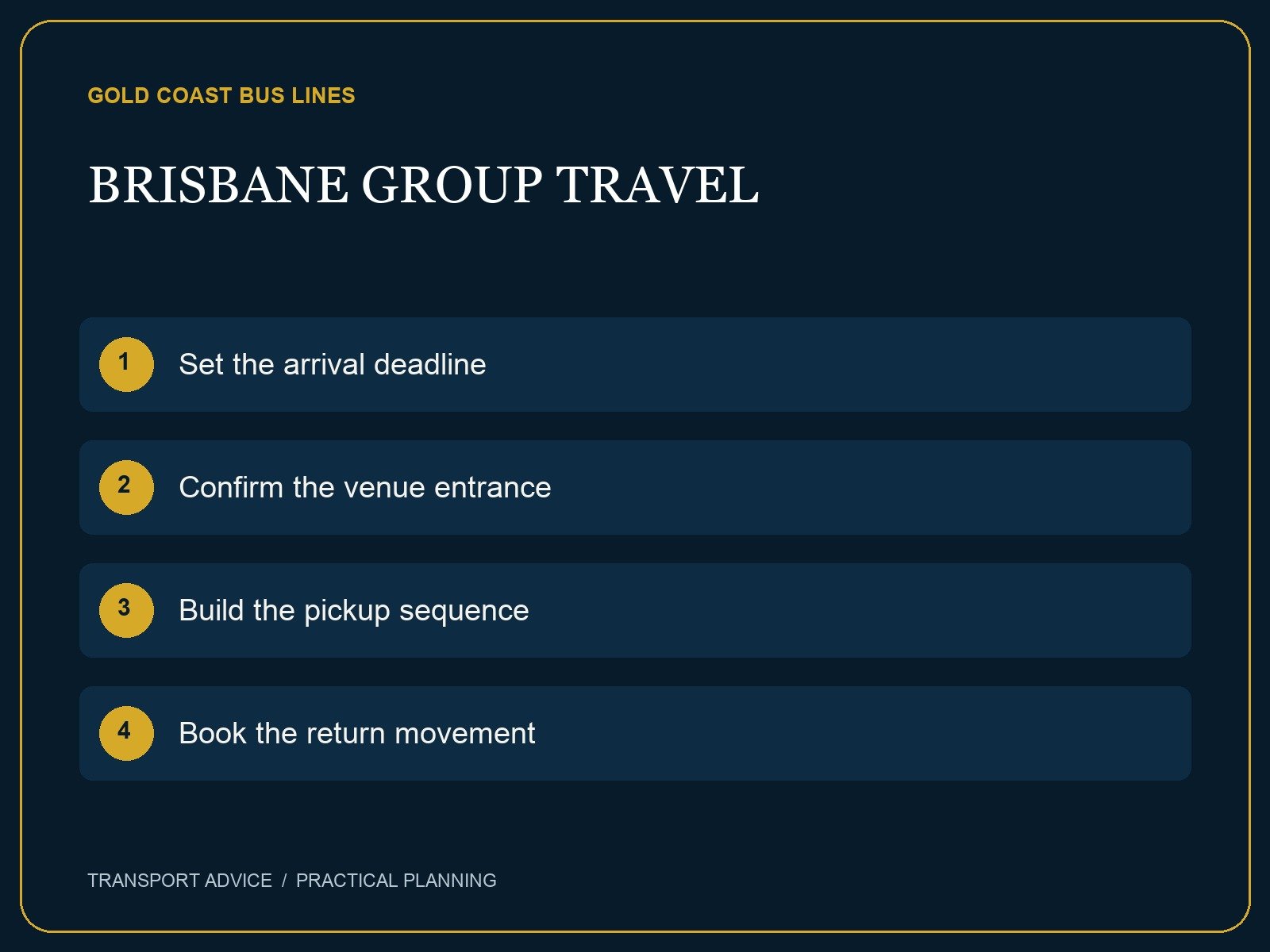
A Gold Coast to Brisbane group trip is usually won or lost at the edges of the journey. The motorway section matters, but so do the hotel entrance, the last passenger leaving breakfast, the correct side of the destination building and the time needed to walk into the event. A bus booked for the right number of seats can still be operating the wrong schedule.
Start with the purpose of the trip: a conference, sporting fixture, theatre visit, private celebration or flight connection. Then define the moment when the group actually needs to be ready. “Arrive in Brisbane at nine” is less useful than “all delegates inside registration by 8:40 am at the nominated entrance”. This guide helps turn that requirement into a workable movement brief.
Choose the destination before estimating the journey
Brisbane CBD, South Bank, an outer-suburban venue, Brisbane Airport and the cruise terminal are separate transport jobs. Do not reuse a city transfer estimate for another destination. Provide the building name, full address, entrance instructions and an onsite contact. A venue postcode does not tell the driver which approach accommodates a coach.
For flights, use the dedicated Brisbane Airport to Gold Coast page and airport group transfer guide. Airport terminal, flight number, baggage collection and airline check-in deadlines need their own allowances. For a ship connection, use the cruise group transfer guide, because a ship’s scheduled arrival is not the same as passengers being ready outside.
If the visit includes several Brisbane destinations, identify each movement. A coach dropping guests at a museum and collecting them after a restaurant visit needs two confirmed access points. An apparently small itinerary change can move the return pickup to a different street or require another approach route.
Work backwards from the deadline
Ask the operator to assess road travel time for the exact date, departure point and destination. A passenger-car map estimate is an input, not a complete group schedule. Roadworks, school holidays, commuter demand, major events, weather and the size of the vehicle can change the practical plan. Check QLDTraffic for current incidents and planned works when finalising the trip.
Build separate allowances for boarding, driving, traffic uncertainty, unloading and walking to the venue. Do not bury all of them in one unexplained “extra half hour”. Separating the components makes it easier to see what has to change if the venue brings registration forward or another hotel is added.
| Schedule component | What the organiser confirms | What needs operator input |
|---|---|---|
| Ready inside venue | Registration or appointment deadline | Suitable drop-off location |
| Walk and unload | Mobility, bags and group check-in | Space and sequence for unloading |
| Road travel | Exact endpoints and date | Route, expected duration and contingency |
| Boarding | Passenger list and meeting time | Vehicle presentation and loading needs |
| Earlier pickups | People assigned to each stop | Stop order, access and departure times |
As an illustration only, suppose a venue requires the group inside at 9:00 am. The organiser allows 20 minutes for unloading and walking, while the operator assesses 100 minutes of road travel plus 30 minutes of contingency. That produces a 6:30 am final departure, with assembly and loading before it. These numbers demonstrate the method; they are not a promised Gold Coast–Brisbane journey time.
Decide whether hotel pickups help or hinder
A single meeting point can simplify departure, but only if passengers can reach it comfortably with their belongings. A group staying across Surfers Paradise, Broadbeach and the northern Gold Coast may need a different arrangement from guests in neighbouring hotels. Compare the time saved by consolidation with the walking or local transfer burden placed on passengers.
For several hotels, allocate people to named stops before travel. Put the earliest pickup’s onboard time on the schedule so the organiser can judge whether the route is becoming unreasonable. Avoid a loop that repeatedly crosses the same precinct because the hotel list was copied in booking order.
Use the multiple-pickup planning section to record assembly times, exact loading points and a late-passenger procedure. A hotel lobby is an assembly point; it may not be the coach loading point. Reception staff should know where the group waits while the vehicle approaches.
Check the Brisbane arrival and waiting arrangements
Ask the venue to distinguish passenger set-down, long-stay coach parking and the return collection point. These may be three different places. Permission to unload does not imply that the vehicle can remain outside throughout an event. Brisbane City Council provides coach parking information; the operator should check the current location, signs and applicable arrangements.
Send the venue’s written instructions to the operator instead of translating them into a vague note such as “near the front”. If several vehicles are coming, establish whether they can unload together or need to arrive in sequence. Passengers should wait in an agreed safe area, with an organiser directing them when their vehicle is ready.
For people who cannot comfortably walk from a remote loading point, discuss the boarding and destination access requirements before confirming the trip. Do not assume that a larger coach is wheelchair accessible or that a venue’s accessible entrance is also an approved coach entrance. The two arrangements need to work together.
Match luggage and equipment to the day
A day conference group may carry small bags; a sporting team could bring kit bags, team equipment and bulky items. Guests checking out of a hotel before the Brisbane visit may also need suitcase storage for the whole day. Count the actual items rather than describing all of them as “a little luggage”.
The fleet overview is a starting point for comparing vehicle sizes. A 50-seater coach is not a blanket promise of space for 50 large suitcases and equipment. Ask the operator to confirm the specific seating and storage arrangement, including whether a trailer or different vehicle is needed and can access the venues.
If bags stay with the vehicle during the visit, agree on availability and retrieval. Keep medication, identification, tickets and other items needed during the event with passengers. The group should not depend on opening the luggage compartment while the driver is away or the vehicle is parked elsewhere.
Make the return a separate plan
The return deserves its own pickup location, assembly time, departure time and passenger list. A dinner may finish later than a conference; some guests may remain in Brisbane while others return to different Gold Coast hotels. Those changes affect routing, vehicle allocation and the headcount.
Set a clear decision point for delays. Name the organiser who can authorise a revised departure and ask what happens if an event overruns. Availability for extra time is subject to the operator’s schedule and driver requirements. It should not be assumed simply because the vehicle completed the outbound trip.
If a few guests need an early return, compare a separate small vehicle with holding the main group to an earlier finish. The one bus versus multiple buses guide explains how different deadlines can justify separate movements. Keep any provisional return option labelled as provisional until it has been accepted.
Worked scenario: conference followed by dinner
Consider 38 delegates staying in two Gold Coast hotels. They need to register at a Brisbane conference, then attend dinner at another address. Six delegates plan to remain in Brisbane. The outbound count is 38, the restaurant transfer count may still be 38, and the Gold Coast return count is 32. Each leg should state its own number.
The organiser sends one movement sheet showing hotel assignments, conference entrance, restaurant loading instructions, luggage and return destinations. The operator assesses whether the same vehicle can perform the full schedule and whether it remains committed between movements. The organiser confirms with both venues where passengers can assemble without blocking an entrance.
Before travel, delegates receive only the details relevant to them: hotel meeting time, named bus group, contact number and final return arrangement. The organiser keeps the full version. This avoids distributing a complicated schedule that encourages passengers to follow the wrong row.
A practical final check
Confirm the final count by stop and by leg, then compare it with the accepted vehicle plan. Check that the venue has the same arrival time as the transport provider. Verify that a nominated contact will answer their phone during boarding and that another person can manage attendance while the organiser speaks with the driver.
Review the route and event notices shortly before travel, and make changes through the booking contact. On the day, count passengers before departure and again at each return collection. A late arrival should trigger the agreed process, not an improvised detour that puts everyone’s deadline at risk.
For a quote, send the full schedule to Gold Coast Bus Lines and identify which times are fixed. The corporate transport service can be the relevant starting point for business groups; private and leisure organisers can use private group transport.
Frequently asked questions
How long should we allow from the Gold Coast to Brisbane?
Use an operator-assessed duration for the actual date and endpoints, then add boarding, unloading, walking and contingency separately. There is no single reliable time covering every Gold Coast hotel and Brisbane destination.
Can the coach wait at our venue all day?
Only if both the booking and the venue arrangements allow it. A drop-off area may not permit waiting, and a transfer booking may release the vehicle between movements. Confirm the operating arrangement in writing.
Can passengers return to different hotels?
Include each return stop and its passenger allocation in the quote request. The return route may differ from the morning route, particularly when some guests stay in Brisbane or depart elsewhere.
Is one coach always the easiest option?
It is often straightforward when everyone shares the same schedule and access is suitable. Separate deadlines, restricted entrances or a small early-return group can make multiple vehicles more practical. Compare complete itineraries rather than seat counts alone.